
What is understood by Knowledge Management (KM)? For which areas of a company or organization is systematic knowledge management significant or even strictly necessary? How should one proceed? What dependencies exist?
Knowledge Management processes have been applied for years, predominantly in connection with IT Service Management (ITSM), and with the adoption of the international standard ISO 9001:2015, they have received recognized guidelines for quality assurance and the certification of KM processes.
Practical experience, as well as the ISO 30401 standard "Knowledge management systems – Requirements", can provide a systematic framework during this transformation to accompany the implementation and monitoring of the strategic goals of the company or organization through a Knowledge Management program and to continuously evaluate them.
Initially, we recommend selecting a KM domain transformation or change model that takes all areas of knowledge management into account, supports comprehensive preparation, planning, and execution of the KM program, and also guarantees integration into a previously initiated "Digital Transformation" program.
The following KM change model – taking into account eight primary KM domains – is recommended as a standard model in the consulting phase. Depending on requirements, domains can be omitted if their maturity level has a low impact on the overall analysis result. For the analysis, assessment, planning, and execution phases, one or more domain-specific maturity models are additionally applied. In the AI field and for semantic solutions or in complex industrial applications, the "Big Data Maturity Model" (BDMM) is also used, for example.
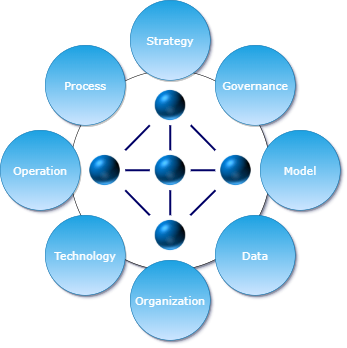
An explanation of the individual KM domains can be found below.
- Strategy – Knowledge management initiatives and programs as an integral part of the company's business strategy and defined goals. KM is one of the primary elements of any Digital Transformation.
- Organization – all people within the fixed or agile organizational structure of the company in various and multiple roles, including users, contributors, decision-makers, managers, experts, as well as the corporate culture regarding the promotion and recognition of knowledge sharing and management. The organization must develop a new culture; it must learn systematic learning.
- Governance – Steering board, governance model and processes, roles, authorities, and quality standards of the company
- Technology – the consistent application of state-of-the-art technologies and methodologies, e.g., artificial intelligence, service-oriented architecture, cloud services, semantic and knowledge graph-based modeling, natural language processing (NLP)
- Process – Processes for creating, managing, and updating content, data, knowledge, employee training and learning processes, quality assurance
- Data – Consideration of structured and unstructured data, documents, websites, databases, videos, emails
- Model – Complete knowledge model (or knowledge graph), a federation of all associated elements, e.g., nomenclature, taxonomy, ontology
- Operation – Integral operation of all KM domain elements or services, continuous monitoring, adaptation, and improvement of knowledge management by measuring relevant indicators as well as optimizing processes and systems, operation of cloud services, infrastructure, business and technical support
Knowledge Management has evolved into one of the most essential core disciplines for companies and organizations in recent years. Through systematic implementation and execution, relevant data, information, and ultimately the knowledge required for competent and rapid decision-making can be made immediately available to all stakeholders in high quality.
The maturity model, utilizing various "maturity levels," is used in this field for visualization in the form of the DIKUW pyramid. This illustrates the complexity of the subject matter and, in particular, the progression from data and information to knowledge that must be understood by humans and machines before correct decisions or conclusions can be drawn.
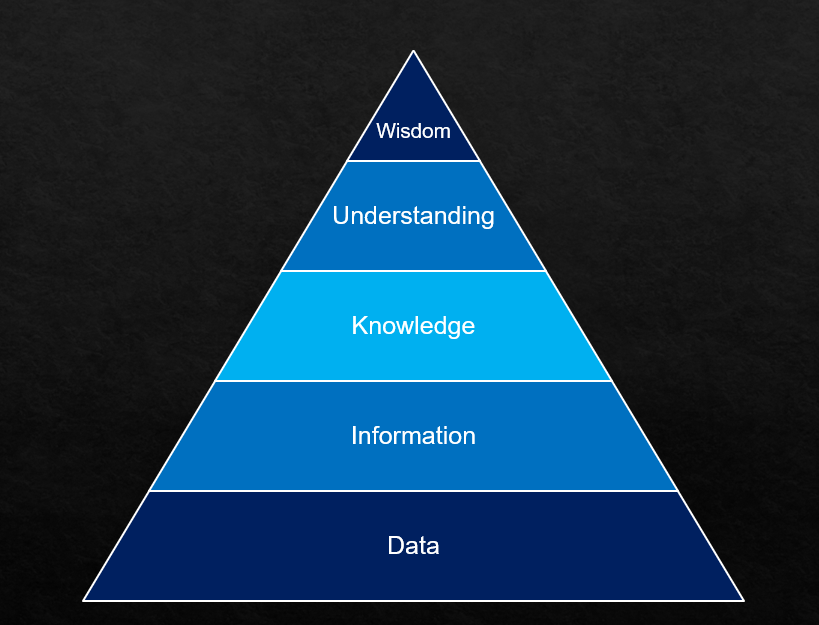
In the digital age, Knowledge Management has a much broader and more complex focus within companies. New, holistic approaches and requirements—particularly in the areas of analysis, classification, and ultimately the search for corporate data, information, and knowledge, as well as the availability of new intelligent technologies such as AI (Artificial Intelligence), ML (Machine Learning), Semantic Web, Knowledge Graphs (KG), and Natural Language Processing (NLP)—often require companies to realign themselves both organizationally and technologically.
Show recent posts on the topics: Artificial Intelligence | Digital Product Passport | Knowledge Management | Context Graph | Knowledge Graph