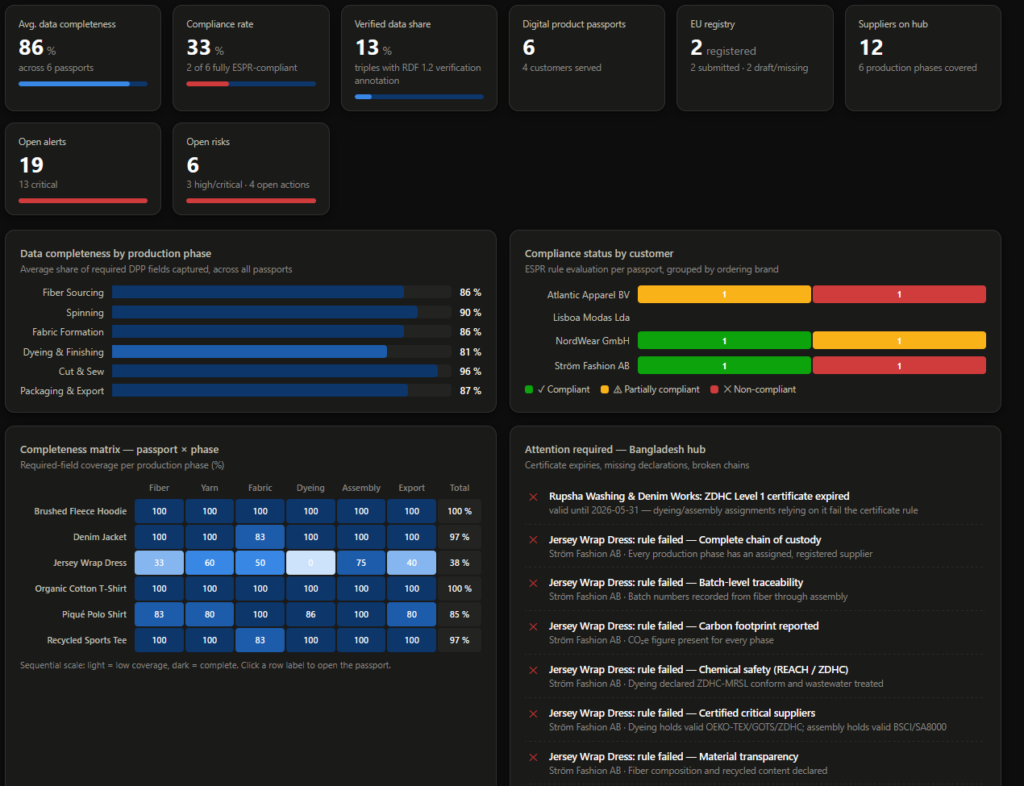
The current beta version of the prototype (v0.18.0) includes various components that enable transparent use for different use cases within the context of the DPP. In addition to the required DPP functionalities, the DPP Hub offers a wide range of management features, which are summarized in the “Cockpit View.” The Hub function can orchestrate various configurations of customer and supplier companies, different product segments, or even separately managed geographic or business clusters.
The figure shows the relevant information for a DPP hub for textiles in Bangladesh. DPP details for 4 international customers (brands) and 12 associated supplier facilities are displayed in real time, including DPP registration and compliance for individual products. Critical risks and alerts are also displayed. Additional (aggregated) metrics from the selected hub perspective can be accessed at any time.
All data is managed in a semantic RDF 1.2 model (in accordance with the W3C standard), thereby ensuring complete semantic interoperability at all times via API interfaces with all external business platforms and systems.
The new prototype of a Digital Product Passport – Compliance Management and Orchestration Hub has been made available for demonstration and collaborative discussion with the team, domain experts, and stakeholders in Bangladesh.
The architecture of the hub supports – alongside monitoring the overall DPP status for Bangladesh for each product, customer, and associated supplier – the detailed presentation of the product carbon footprint according to the GHG Protocol, an AI-based natural language search, and also ensures DPP standard interoperability via an API interface with the DPP platform and service providers (to be selected for Bangladesh).
The semantic core of the prototype is formed by a W3C-compliant Context Graph, which additionally captures and visualizes all temporal relationships of product and status changes.
To provide a realistic demonstration of the orchestrator's functionalities, sample data was provided and used for this version of the prototype. The screenshot shows the EU registry detail view for all included products.
The current beta version of the prototype includes the following functionalities:
Cockpit / Dashboard
Customer view featuring linked products and suppliers, along with compliance status
Product details with status and primary DPP data, including the complete Product Carbon Footprint (PCF)
List of suppliers with their associated products, including certificate status
Hub onboarding status and details regarding customer and supplier contracts
Risks and actions, presented in a risk register and evaluated in a risk matrix
Status and details of the EU DPP registration with primary and backup DPP links
Visualization of all relationships within an interactive context graph and display of product-related temporal changes
Detailed breakdown of the PCF (Product Carbon Footprint) values for all suppliers of a product, incorporating the product BOM (Bill of Materials)
Versatile search options, using either predefined (semantic) queries or natural language, powered by cloud-based or local AI services
Password-protected admin area for managing customers, products, and suppliers, configuring API interfaces with DPP providers, and handling import/export functions in various formats.
In the coming weeks, additional posts will be published introducing and explaining the individual features. Please send any questions, suggestions, or feedback via LinkedIn or email.
I am offering another comprehensive (1080°) consulting service for businesses, titled "From Digital Obligation to True Competitive Advantage", in collaboration with two highly experienced partners.
You can find details about this special offer in the flyer . Please feel free to contact us if you are interested or have any questions about our services.
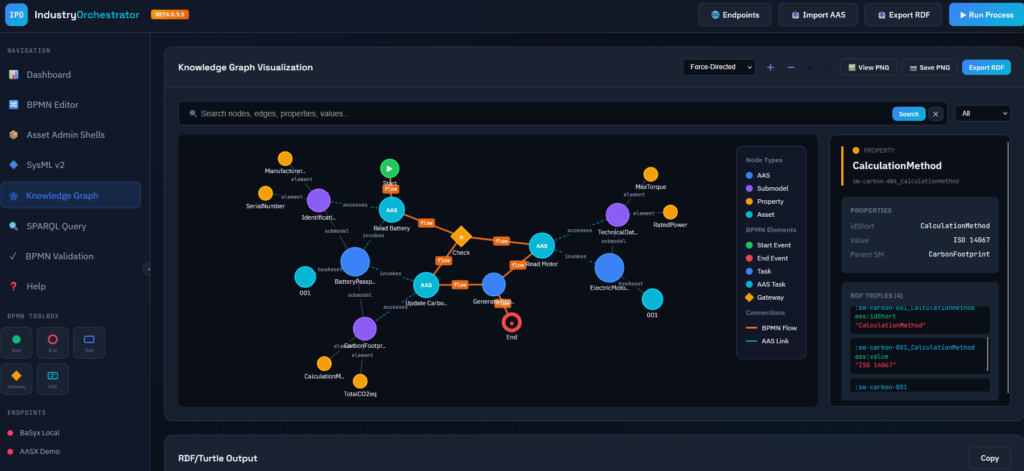
The first beta version of the IPO prototype is now available. The aim of this prototype is to demonstrate the comprehensive application of industry standards in combination with semantic solutions and Artificial Intelligence. Another key focus during development was the inclusion and integration of validation functions. The main applications of this prototype include the Digital Product Passport, the calculation of the product's Product Carbon Footprint (PCF) in accordance with the ISO 14067 standard, and integration into the company's process landscape. An agile, incremental approach was used to develop the web application.
IPO Prototype – Visualized Knowledge Graph with detailed view and search function
The standards supported in the IPO prototype are BPMN 2.0, SysML v2, AAS (3.0) with submodels, RDF/Turtle, SPARQL, and SHACL. Import and export functions are available for SysML, BPMN 2.0, SysML v2, and AAS.
This year, KMAIC has been supporting circulardata, an independent initiative for sharing and pooling sustainable activities, particularly in the context of the Digital Product Passport. Further details can be found at https://circular-data.org/o/f2df6055-7f34-4766-addd-ca8a6c171f25
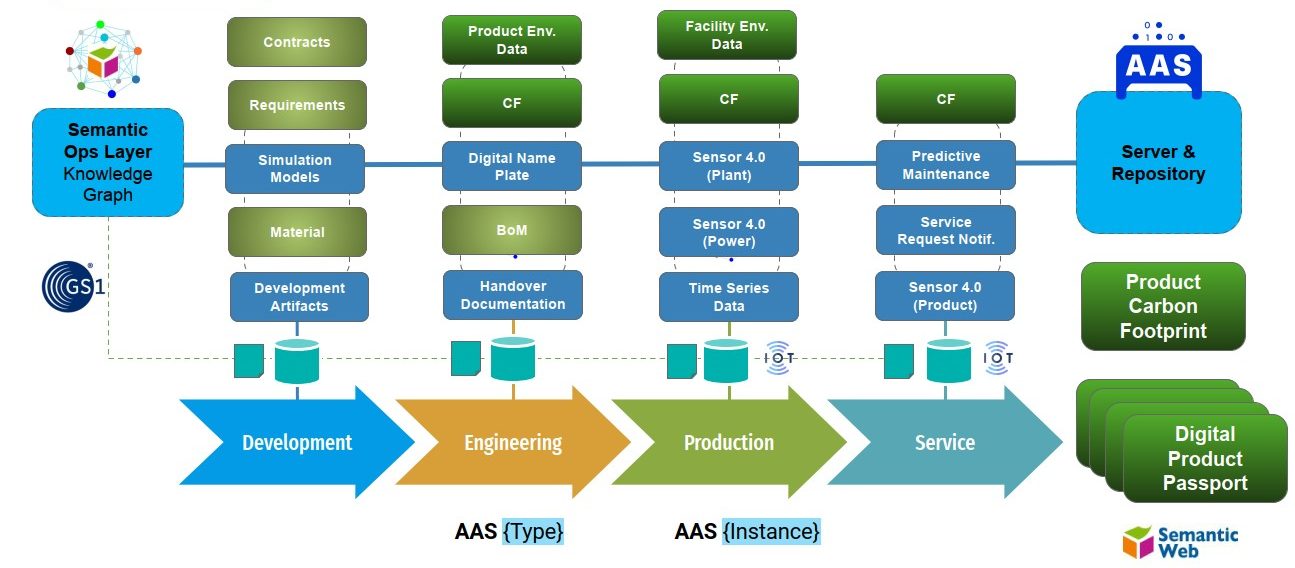
The Digital Product Passport requires access to all relevant data as well as the "semantic interconnection" of this data within a company. Furthermore, connectivity with external data from suppliers and partners is also necessary. This interoperability—which also supports the exchange of Digital Twins—can be achieved through the use of the open standard of the Asset Administration Shell (IEC 63278-1). In addition, full interoperability requires seamless integration with existing business processes and models within the company, such as in Product Engineering / Model-Based Systems Engineering, as well as the orchestration of relationships at the data, model, and process levels. Model-based methods and descriptions (BPMN 2.0, SysML v2, AutoML, LLM, Predictive Maintenance) are already applied in many subareas of companies. The complete networking of these complex contexts and aspects can be realized using a semantic enterprise model based on World Wide Web Consortium (W3C) web standards, thereby contributing to further value creation within the company.
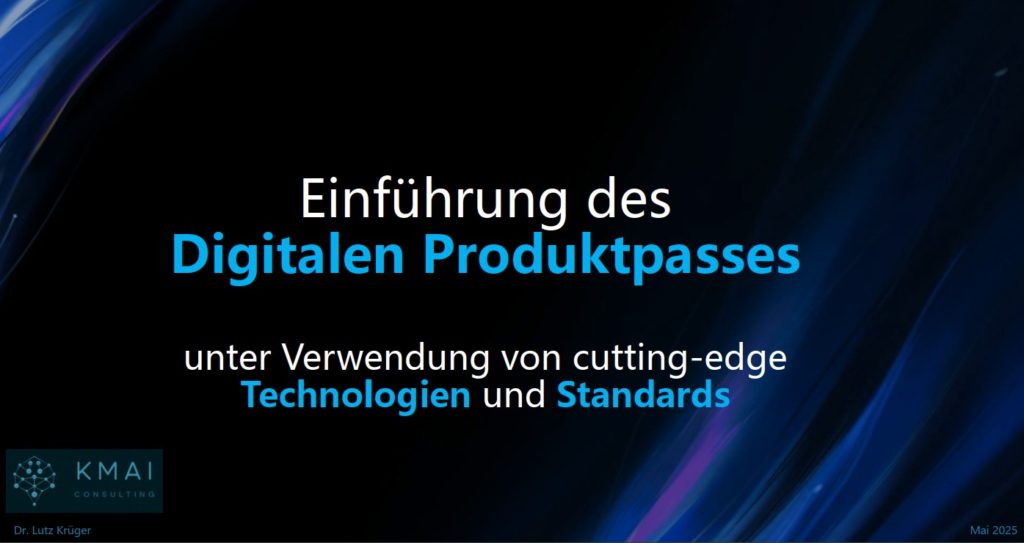
This presentation from Semantics 2023 explains the key points of the European Green Deal, related sustainable product initiatives and standards, and—as a use case—concepts for implementing the Digital Product Passport (DPP) based on the latest technologies and frameworks, such as the application of the Asset Administration Shell (AAS) in combination with an Enterprise Knowledge Graph (EKG).
To provide the best possible experiences, we use technologies like cookies to store and/or access device information. Consenting to these technologies allows us to process data such as browsing behavior or unique IDs on this site. Not consenting or withdrawing consent may adversely affect certain features and functions.
Functional
Always active
The technical storage or access is strictly necessary for the legitimate purpose of enabling the use of a specific service explicitly requested by the subscriber or user, or for the sole purpose of carrying out the transmission of a communication over an electronic communications network.
Preferences
The technical storage or access is necessary for the legitimate purpose of storing preferences that are not requested by the subscriber or user.
Statistics
The technical storage or access that is used exclusively for statistical purposes.The technical storage or access that is used exclusively for anonymous statistical purposes. Without a subpoena, voluntary compliance on the part of your Internet Service Provider, or additional records from a third party, information stored or retrieved for this purpose alone cannot usually be used to identify you.
Marketing
The technical storage or access is required to create user profiles to send advertising, or to track the user on a website or across several websites for similar marketing purposes.