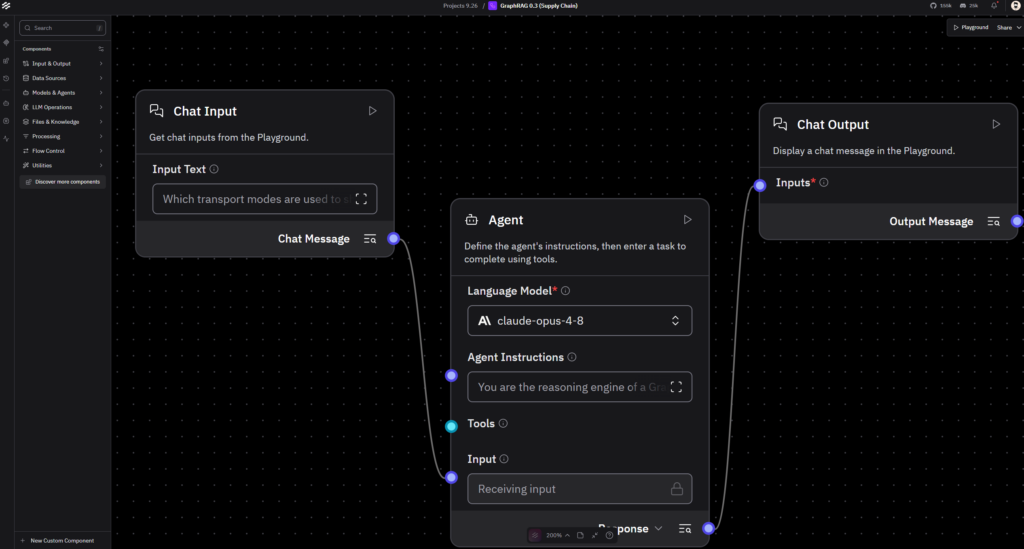
A few years ago, while searching for a suitable open-source AI development platform, I came across the development environment Langflow from DataStax. It was originally developed by Logspace, acquired by DataStax in 2024, and acquired by IBM in 2025.
With Langflow , complex AI workflows, applications, or agentscan be created and tested using a visual user interface. An extensive library provides many components that enable the easy development of complex pipelines via drag-and-drop. In addition , there are ready-made solution templates that can be customized and used immediately. Users are free to choose the AI models they want.
The overview shows a pipeline that was able to demonstrate and illustrate the functionality and benefits of a GraphRAG—in conjunction with a semantic model (Context Graph) in the W3C standard format RDF 1.2—for a customer in the context of supply chain processes.
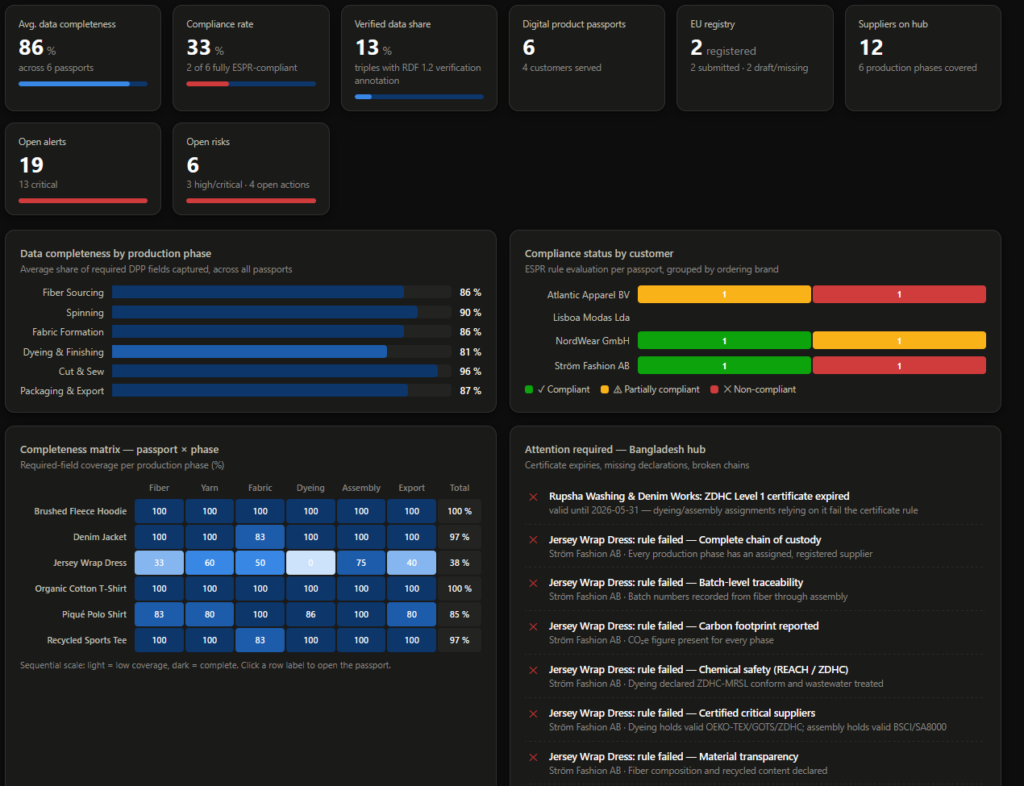
The current beta version of the prototype (v0.18.0) includes various components that enable transparent use for different use cases within the context of the DPP. In addition to the required DPP functionalities, the DPP Hub offers a wide range of management features, which are summarized in the “Cockpit View.” The Hub function can orchestrate various configurations of customer and supplier companies, different product segments, or even separately managed geographic or business clusters.
The figure shows the relevant information for a DPP hub for textiles in Bangladesh. DPP details for 4 international customers (brands) and 12 associated supplier facilities are displayed in real time, including DPP registration and compliance for individual products. Critical risks and alerts are also displayed. Additional (aggregated) metrics from the selected hub perspective can be accessed at any time.
All data is managed in a semantic RDF 1.2 model (in accordance with the W3C standard), thereby ensuring complete semantic interoperability at all times via API interfaces with all external business platforms and systems.
The new prototype of a Digital Product Passport – Compliance Management and Orchestration Hub has been made available for demonstration and collaborative discussion with the team, domain experts, and stakeholders in Bangladesh.
The architecture of the hub supports – alongside monitoring the overall DPP status for Bangladesh for each product, customer, and associated supplier – the detailed presentation of the product carbon footprint according to the GHG Protocol, an AI-based natural language search, and also ensures DPP standard interoperability via an API interface with the DPP platform and service providers (to be selected for Bangladesh).
The semantic core of the prototype is formed by a W3C-compliant Context Graph, which additionally captures and visualizes all temporal relationships of product and status changes.
To provide a realistic demonstration of the orchestrator's functionalities, sample data was provided and used for this version of the prototype. The screenshot shows the EU registry detail view for all included products.
The current beta version of the prototype includes the following functionalities:
Cockpit / Dashboard
Customer view featuring linked products and suppliers, along with compliance status
Product details with status and primary DPP data, including the complete Product Carbon Footprint (PCF)
List of suppliers with their associated products, including certificate status
Hub onboarding status and details regarding customer and supplier contracts
Risks and actions, presented in a risk register and evaluated in a risk matrix
Status and details of the EU DPP registration with primary and backup DPP links
Visualization of all relationships within an interactive context graph and display of product-related temporal changes
Detailed breakdown of the PCF (Product Carbon Footprint) values for all suppliers of a product, incorporating the product BOM (Bill of Materials)
Versatile search options, using either predefined (semantic) queries or natural language, powered by cloud-based or local AI services
Password-protected admin area for managing customers, products, and suppliers, configuring API interfaces with DPP providers, and handling import/export functions in various formats.
In the coming weeks, additional posts will be published introducing and explaining the individual features. Please send any questions, suggestions, or feedback via LinkedIn or email.
When humans, AI agents, and humanoid robots are equally involved in business processes and value chains within a company, traditional hierarchical organizational structures often lack the agility required to respond immediately to market changes. In such cases, considering alternative organizational models can be extremely beneficial. Holacracy is one potential alternative.
Holacracy is a self-organizing operational model for businesses, formalized in 2007 by Brian J. Robertson. Instead of a traditional hierarchy consisting solely of individuals (arranged in groups, departments, etc.), it utilizes a structure composed of roles with clearly defined components:
Purpose – the target, capabilities, and potential of the role,
Domain – the assets and processes over which the role has sole authority,
Accountabilities – ongoing responsibilities that the role fulfills within its domain or provides as support for other domains.
Activities are bounded by policies, which apply specifically to a given domain or centrally across the entire organization.
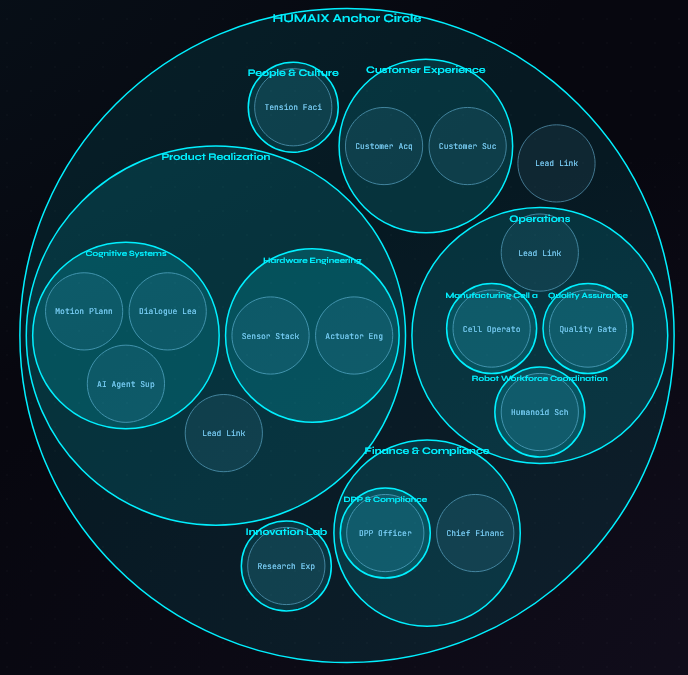
Roles are grouped and organized into circles. Structural changes are not "ordered" from above, but rather adopted collaboratively during governance meetings in response to a specific tension (a perceived discrepancy between the current reality and the desired state).
Es findet eine Trennung zwischen Rolle <> Person statt. Eine Rolle wird von einer Person „energisiert“. Was passiert aber, wenn der „Energizer“ kein Mensch mehr ist, sondern eine intelligente, selbstlernende (AI-basierte) Maschine?
An AI agent (e.g., an AI-based agent for maintenance diagnostics) has a purpose within a specific domain (e.g., "diagnostic recommendations for operating the 'HUMA-7' machine"). It independently executes ongoing accountabilities (monitoring machine logs, reporting anomalies, generating reports, sending notifications, and making predictions based on real-time data). Structurally, it is no different from a human role holder.
To illustrate this, a specific (fictional) yet technically plausible application—the production of a humanoid robot (HUMA-7)—was developed as a prototype. The simulated company employs 13 humans, alongside 6 AI agents and 8 humanoid robots. The prototype can be controlled and monitored using various visualizations, simulations, and optimization strategies. A core module of the prototype is the semantic model of the entire enterprise, which also contains time-dependent data and milestones in a semantic format. This model utilizes the W3C RDF 1.2 standard as a (temporal) context graph, thereby guaranteeing a complete semantic view of all operations at any given point in time—including retrospectively—as well as interoperability with other internal or external processes.
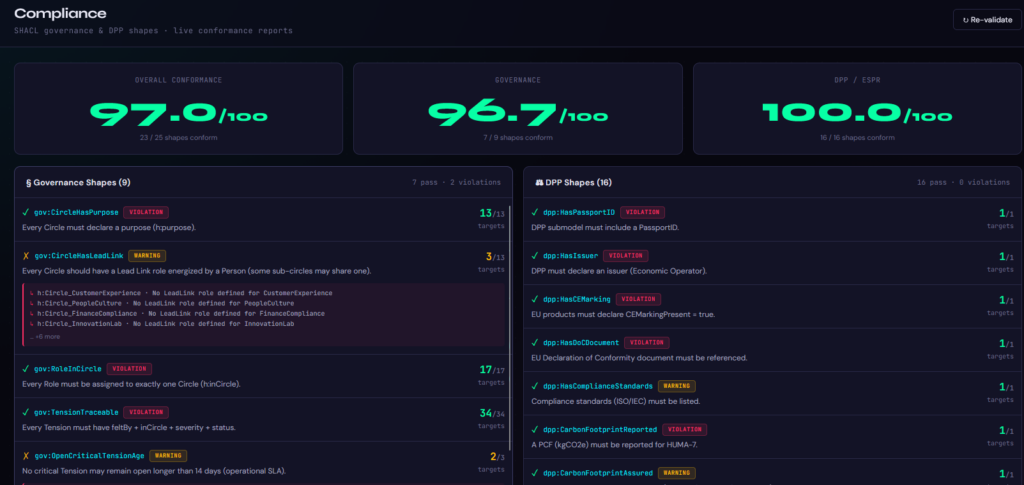
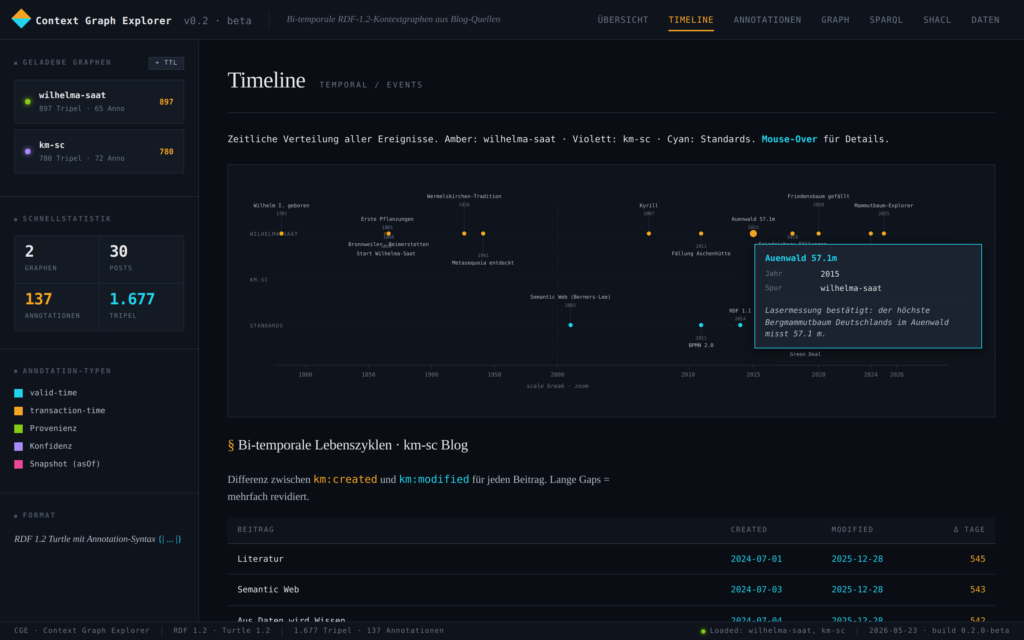
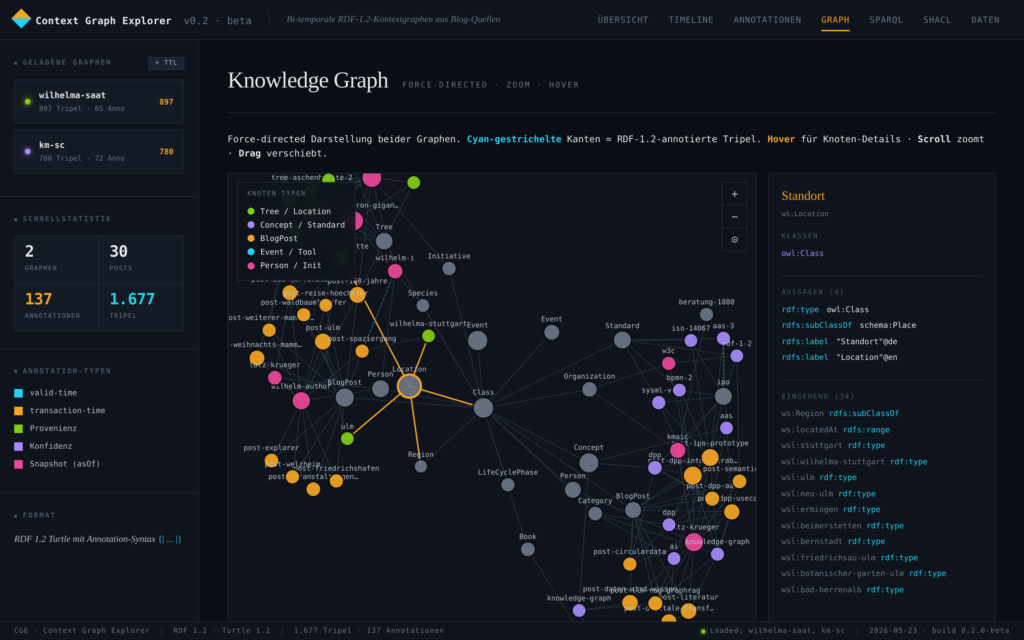
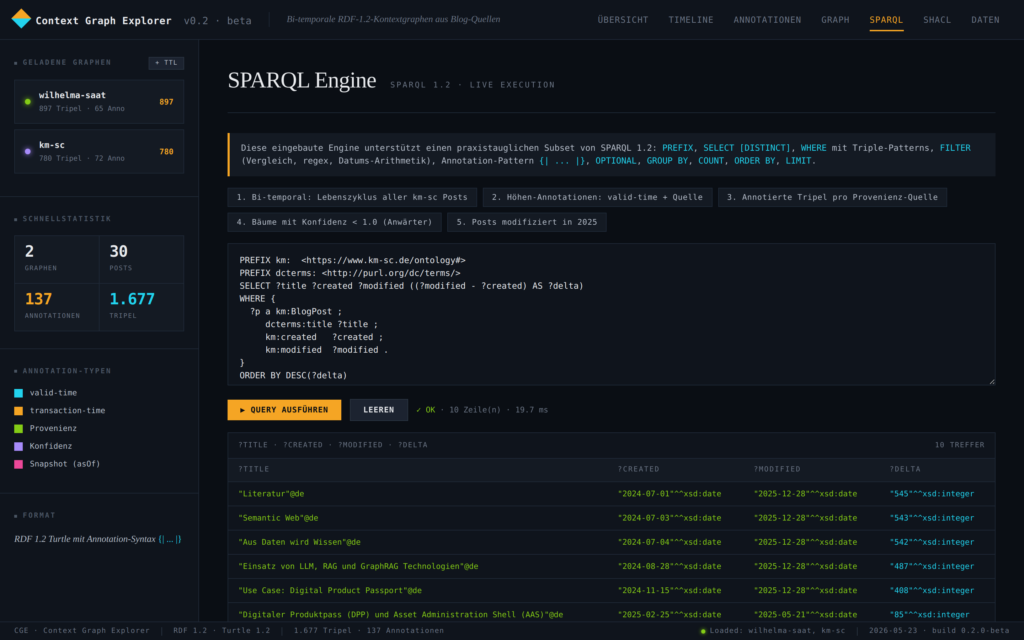
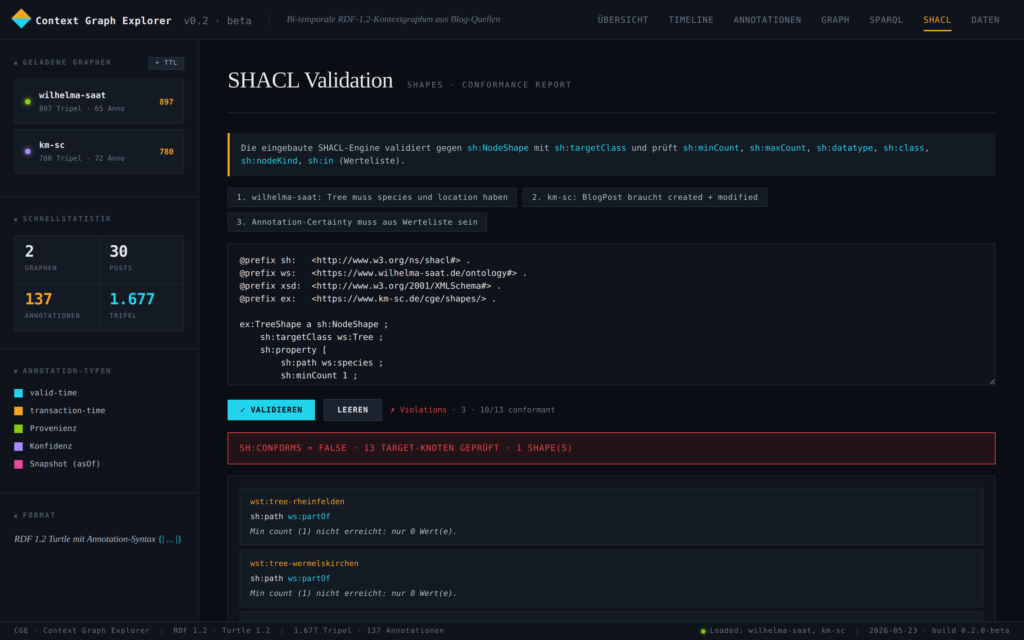
With the new W3C standard RDF 1.2, knowledge graphs can be effectively extended to include time, provenance, and confidence statements, forming a (temporal) Context Graph. This article outlines the fundamentals, several use cases, and the features of the prototype. The prototype provides visualization, import and export functionalities, as well as querying and validation capabilities using a SPARQL 1.2 engine and a SHACL validator.
A traditional Knowledge Graph answers the question "what is related to what?", represented as a directed graph consisting of nodes and edges. A Context Graph complements these statements with additional dimensions related to the context of the node, such as:
valid-time — when was the statement valid in the real world?
transaction-time — when was it recorded, confirmed, or revised?
provenance and confidence — where does it come from and how reliable is this statement?
With the W3C standard RDF 1.2, this can be expressed very effectively using annotation block syntax – indicated by curly braces and pipe symbols – shown here for a giant sequoia in an alluvial forest, measured on September 1, 2015, at a height of 57.1 m.
This extension of the knowledge graph offers significant added value, for instance, in connection with the product development process, the Digital Product Passport (DPP), or in the management of historical or regulated data. Data changes at specific points in time, sources shift, and new or updated regulations come into force – the context graph allows this to be fully documented and later utilized through queries and validations.
For the prototype, context graphs were generated from two different sources.
Wilhelma-Saat — Publications on a nature project documenting the historical giant sequoias of the "Wilhelma-Saat" established by King Wilhelm I of Württemberg (dating back to 1864). The context graph contains 897 triples with 65 annotations and covers the time span from 1781 to 2026. ( https://www.wilhelma-saat.de )
KMAIC Blog — The blog of the KMAIC website, with each post timestamped for initial publication and modification. The context graph contains 780 triples with 72 annotations. ( https://www.km-sc.de )
The prototype can ingest context graphs in RDF format and visualize them as a graph or timeline. Details can be queried using the built-in SPARQL engine, and they can also be validated using the integrated SHACL engine.
Outlook
A context graph represents the logical evolution of the knowledge graph. Its value becomes apparent where static statements without additional dimensions are insufficient. Additional applications and use cases are also beneficial in the following areas:
Regulatory compliance (DPP, ESPR, Battery Regulation 2023/1542) requires traceable data origin and up-to-date status — both of which can be modeled directly as annotations, queried via SPARQL, and validated using SHACL.
Product management, digital twins, and product carbon footprints require tracking when product properties change over time (maintenance status, recycled content, CO₂ footprint, etc.).
Modern AI-based knowledge management systems benefit from provenance and confidence annotations when GraphRAG-generated statements coexist with validated statements from a domain expert — the context graph can indicate which source provided which statement at what time and how trustworthy it is.
I am offering another comprehensive (1080°) consulting service for businesses, titled "From Digital Obligation to True Competitive Advantage", in collaboration with two highly experienced partners.
You can find details about this special offer in the flyer . Please feel free to contact us if you are interested or have any questions about our services.
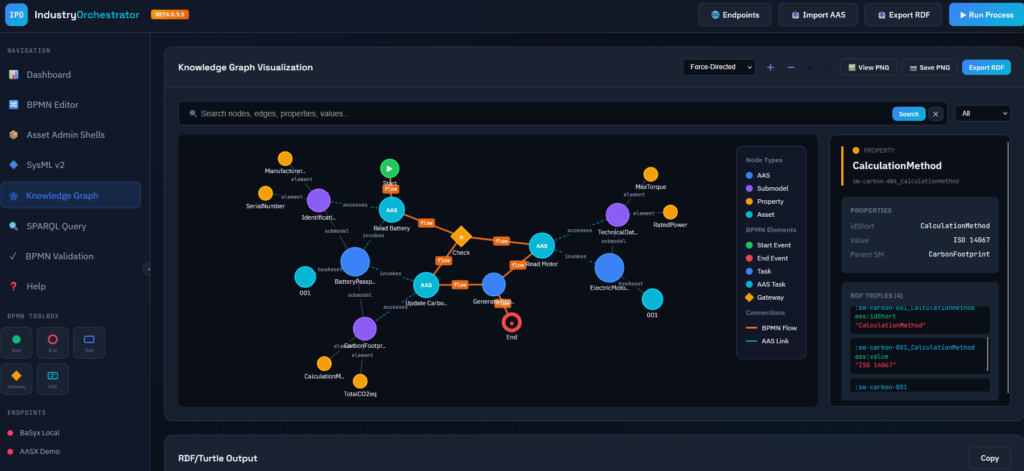
The first beta version of the IPO prototype is now available. The aim of this prototype is to demonstrate the comprehensive application of industry standards in combination with semantic solutions and Artificial Intelligence. Another key focus during development was the inclusion and integration of validation functions. The main applications of this prototype include the Digital Product Passport, the calculation of the product's Product Carbon Footprint (PCF) in accordance with the ISO 14067 standard, and integration into the company's process landscape. An agile, incremental approach was used to develop the web application.
IPO Prototype – Visualized Knowledge Graph with detailed view and search function
The standards supported in the IPO prototype are BPMN 2.0, SysML v2, AAS (3.0) with submodels, RDF/Turtle, SPARQL, and SHACL. Import and export functions are available for SysML, BPMN 2.0, SysML v2, and AAS.
This year, KMAIC has been supporting circulardata, an independent initiative for sharing and pooling sustainable activities, particularly in the context of the Digital Product Passport. Further details can be found at https://circular-data.org/o/f2df6055-7f34-4766-addd-ca8a6c171f25
The Digital Product Passport requires access to all relevant data as well as the "semantic interconnection" of this data within a company. Furthermore, connectivity with external data from suppliers and partners is also necessary. This interoperability—which also supports the exchange of Digital Twins—can be achieved through the use of the open standard of the Asset Administration Shell (IEC 63278-1). In addition, full interoperability requires seamless integration with existing business processes and models within the company, such as in Product Engineering / Model-Based Systems Engineering, as well as the orchestration of relationships at the data, model, and process levels. Model-based methods and descriptions (BPMN 2.0, SysML v2, AutoML, LLM, Predictive Maintenance) are already applied in many subareas of companies. The complete networking of these complex contexts and aspects can be realized using a semantic enterprise model based on World Wide Web Consortium (W3C) web standards, thereby contributing to further value creation within the company.
To provide the best possible experiences, we use technologies like cookies to store and/or access device information. Consenting to these technologies allows us to process data such as browsing behavior or unique IDs on this site. Not consenting or withdrawing consent may adversely affect certain features and functions.
Functional
Always active
The technical storage or access is strictly necessary for the legitimate purpose of enabling the use of a specific service explicitly requested by the subscriber or user, or for the sole purpose of carrying out the transmission of a communication over an electronic communications network.
Preferences
The technical storage or access is necessary for the legitimate purpose of storing preferences that are not requested by the subscriber or user.
Statistics
The technical storage or access that is used exclusively for statistical purposes.The technical storage or access that is used exclusively for anonymous statistical purposes. Without a subpoena, voluntary compliance on the part of your Internet Service Provider, or additional records from a third party, information stored or retrieved for this purpose alone cannot usually be used to identify you.
Marketing
The technical storage or access is required to create user profiles to send advertising, or to track the user on a website or across several websites for similar marketing purposes.