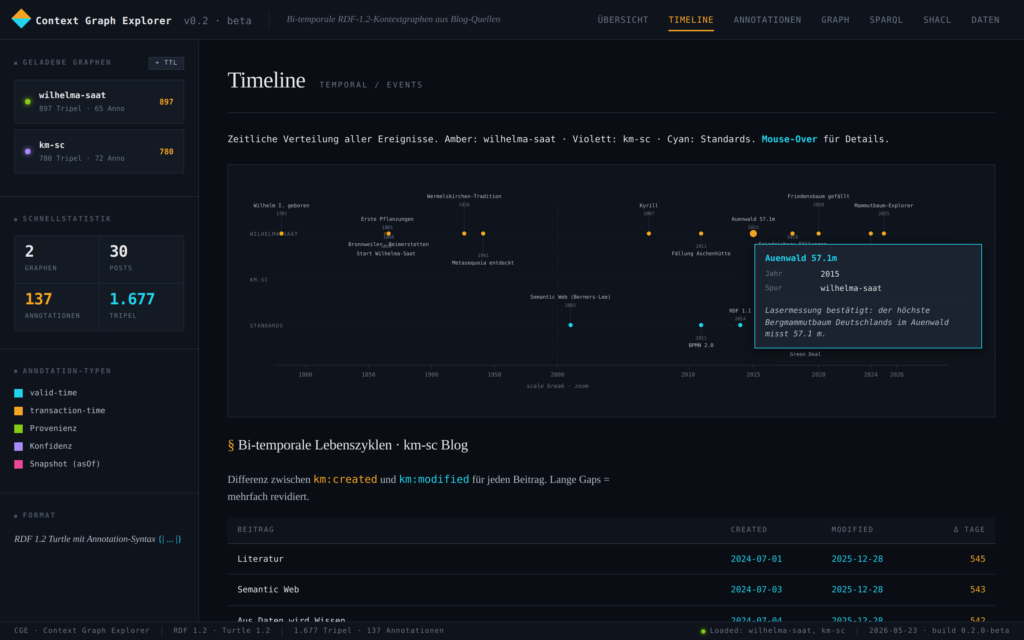
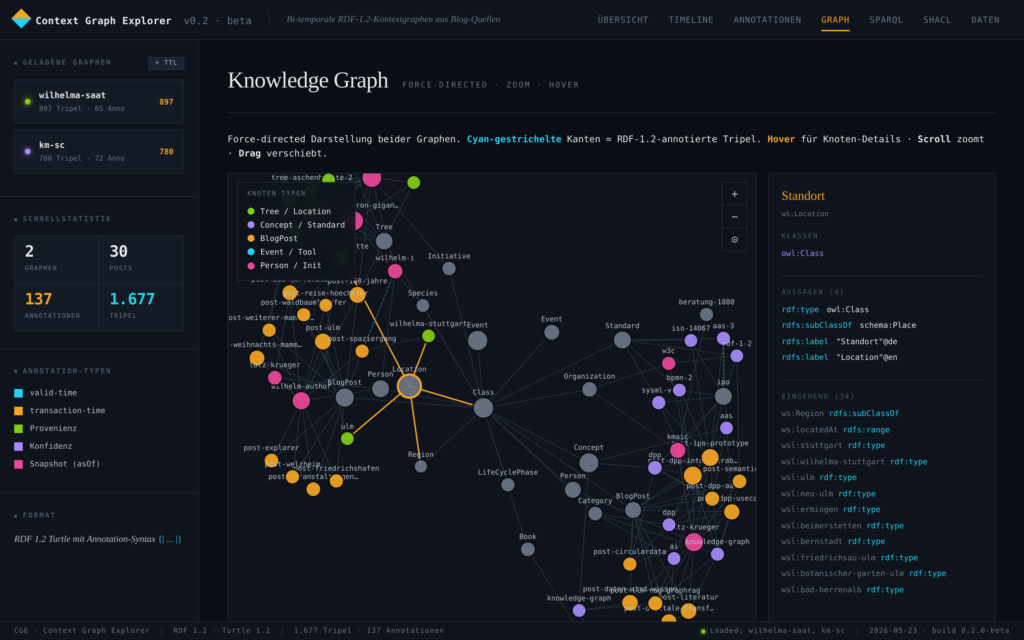
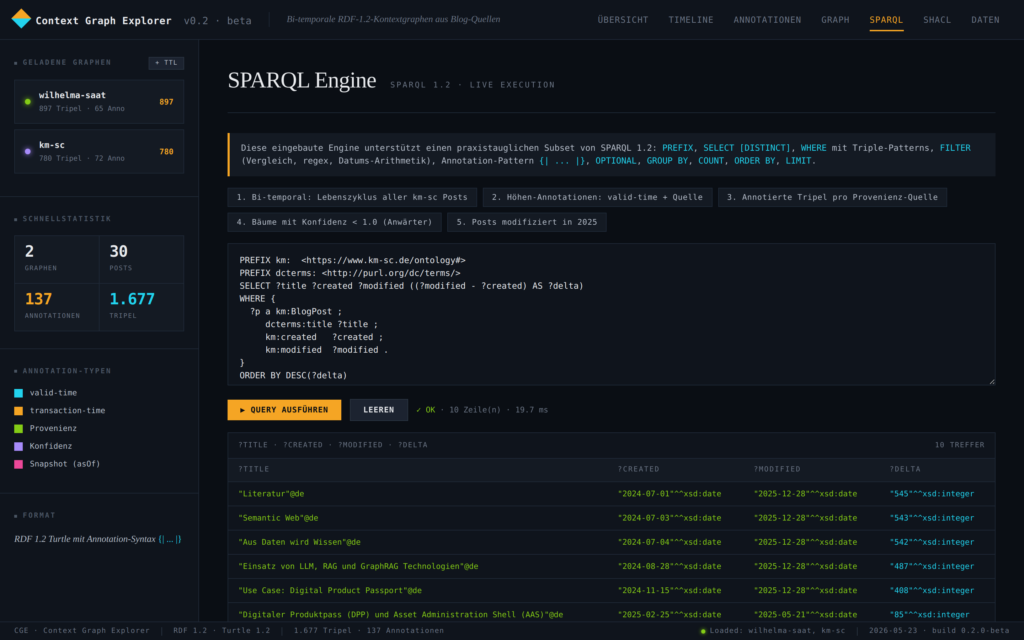
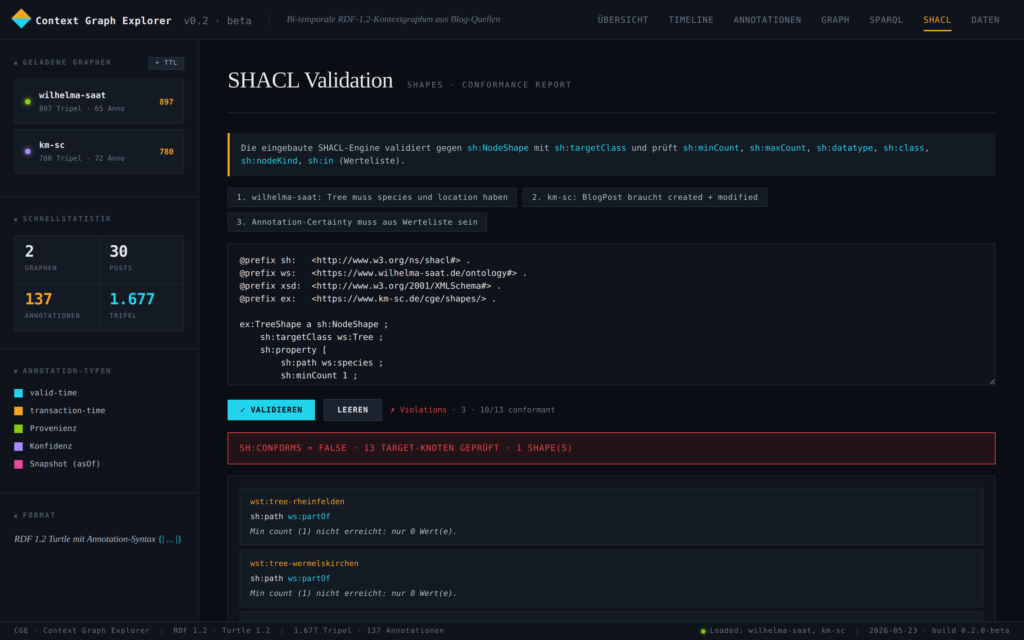
Context Graph Explorer with the Latest W3C Standard RDF 1.2 – Application, Visualization, and Prototype

With the new W3C RDF 1.2 standard, knowledge graphs can be easily extended to include time, provenance, and confidence statements to form a (temporal) context graph . This article describes the fundamentals, several use cases, and the features of the prototype. The prototype provides visualization, import and export capabilities, as well as query and validation options using a SPARQL 1.2 engine and a SHACL validator.

A classic knowledge graph answers the question “What is related to what?”, represented as a directed graph consisting of nodes and edges. A context graph supplements these statements with additional dimensions related to the context of the node, for example:

  • valid-timeWhen was the statement valid in the real world?
  • transaction-timewhen was it recorded, confirmed, or revised?
  • Provenance and ConfidenceWhere does this information come from, and how reliable is this statement?

Using the W3C RDF 1.2 standard, this can be specified very effectively using the annotation block syntax —with curly braces and pipe characters—as shown here for a sequoia in the floodplain forest, which was measured on September 1, 2015, at a height of 57.1 m.

wst:tree-auenwald  ws:heightMeters "57.1"^^xsd:decimal  {|
    ws:validFrom    "2015-09-01"^^xsd:date ;
    ws:source       wsb:post-hoechster-mammutbaum-deutschlands ;
    ws:certainty    "bestaetigt" ;
    ws:confidence   "1.0"^^xsd:decimal ;
    ws:recordedAt   "2015-10-01T12:00:00Z"^^xsd:dateTime
|} .

This extension of the Knowledge Graph provides significant added value, for example, in the context of the product development process, the Digital Product Passport (DPP), or when managing historical or regulated data —data changes at specific points in time, sources change, and new or expanded regulations come into effect. With the Context Graph, all of this can be fully documented and later utilized for querying and validation.

For the prototype, a context graph was generated from each of two different sources.

  • Wilhelma Seed — Publications on a nature project documenting the historic mountain sequoias of the “Wilhelma Seed” planted by King Wilhelm I of Württemberg (in 1864). The Context Graph contains 897 triples with 65 annotations, documenting the time period from 1781 to 2026. ( https://www.wilhelma-saat.de )
  • KMAIC Blog — the blog on the KMAIC website, with each post including timestamps for its initial publication and modifications. The Context Graph contains 780 triples with 72 annotations. ( https://www.km-sc.de )

The Prototype can import context graphs in RDF format and visualize them as a graph or timeline. The built-in SPARQL engine allows you to query the details, and the built-in SHACL engine allows you to validate them as well.

Outlook

A context graph is the logical evolution of the knowledge graph. Its added value lies in situations where static statements without an additional dimension are insufficient. Additional applications and use cases also appear to be useful in the following areas:

  • Regulatory requirements (DPP, ESPR, Battery Regulation 2023/1542) mandate traceable data provenance and timeliness—both of which can be directly modeled as annotations, queried using SPARQL, and validated using SHACL.
  • Product management, digital twins, and product carbon footprints require tracking when product characteristics change over time (maintenance status, recycled content, CO₂ footprint, etc.).
  • Modern AI-based knowledge management systems benefit from provenance and confidence annotations when statements generated by GraphRAG coexist alongside validated statements from a domain expert—the Context Graph can specify which source provides which statement at what time and how trustworthy it is.
Comprehensive (1080°) Consulting for Businesses

Together with two highly experienced partners, I offer another comprehensive (1080°) consulting service for businesses titled“From Mandatory Digital
to Genuine Competitive Strength.”

360° Business Efficiency & 360° Transformation & 360° Knowledge & Leadership

You 'll find details about this special offer in the flyer . Please contact us if you're interested or have any questions about the offers.

Industry 4.0 Orchestrator and Validator Prototype

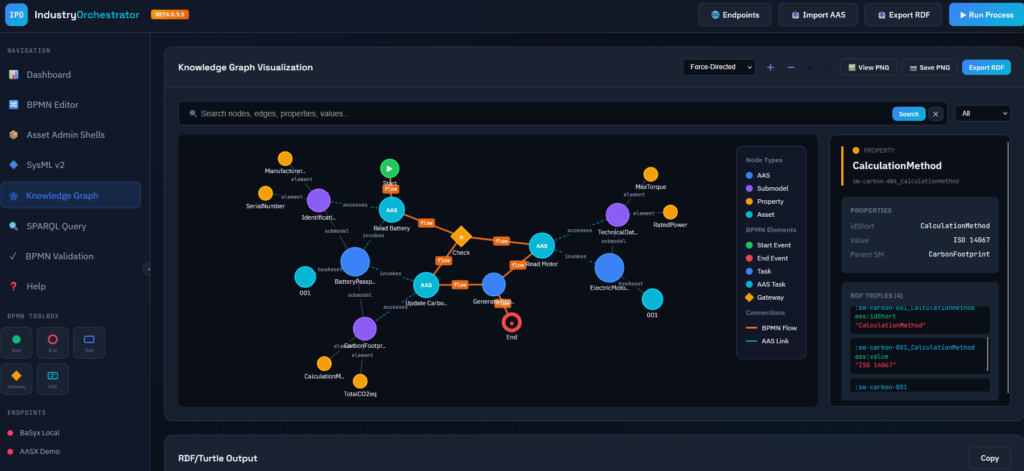
The first beta version of the IPO prototype is now available. The goal of this prototype is to demonstrate the comprehensive application of industry standards—in conjunction with semantic solutions and artificial intelligence. Another key focus during development was the consideration and integration of validation functions. The Digital Product Passport, the calculation of the product’s carbon footprint (PCF) in accordance with ISO 14067, and integration into the company’s process landscape are the main applications of this prototype. An agile, incremental approach was used to develop the web application.

IPO Prototype – Visualized Knowledge Graph with Detailed View and Search

The standards supported by IPO Prototype are BPMN 2.0, SysML v2, AAS (3.0) with submodels, RDF/Turtle, SPARQL, and SHACL. Import and export functions are available for SysML, BPMN 2.0, SysML v2, and AAS.

Digital Product Passport and Interoperability

The Digital Product Passport requires access to all relevant data as well as the“semantic interconnection”of this data within a company. In addition, interconnection with external data from suppliers and partners is also necessary. This interoperability— which also supports the exchange of digital twins—can be achieved through the use of the open Asset Administration Shell standard (IEC 63278-1). Furthermore, full interoperability requires seamless integration with existing business processes and models within the company—for example, in product engineering and model-based system engineering—as well as the orchestration of relationships at the data, model, and process levels. Model-based methods and descriptions (BPMN 2.0, SysML v2, AutoML, LLM, Predictive Maintenance) are already in use in many areas of the enterprise. The complete interconnection of these complex relationships and aspects can be achieved using a semantic enterprise model based on web standards (W3C), thereby contributing to further value creation within the company.

Note: I gave this presentation in November 2025 at the tekom Annual Conference (Arena) in Stuttgart.

Use Case: Digital Product Passport

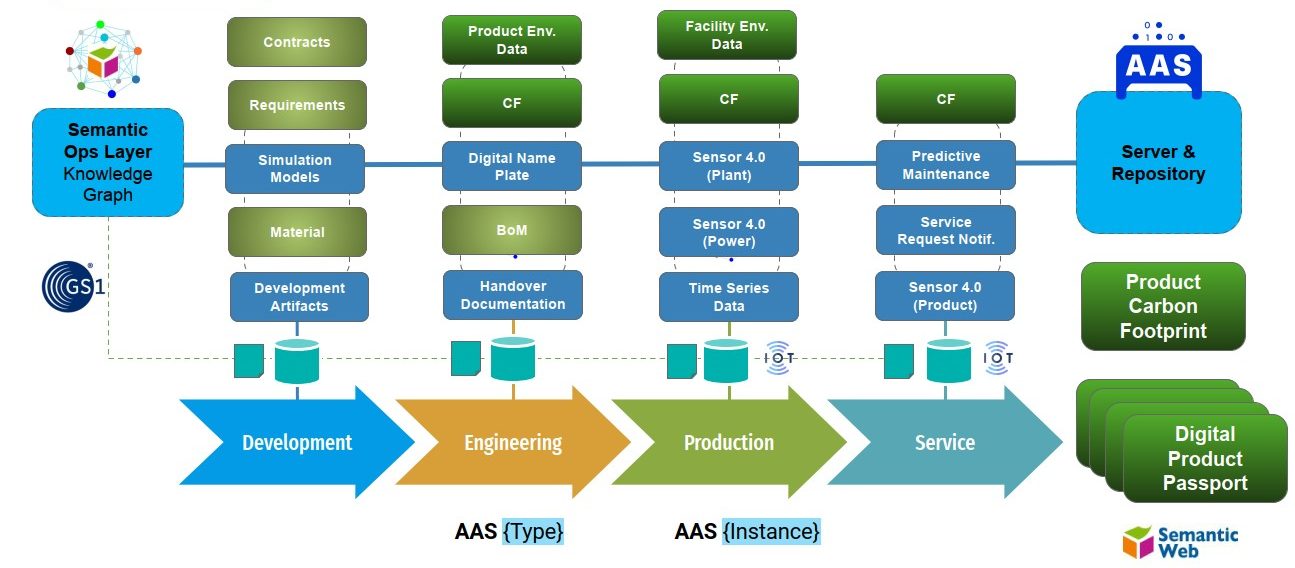
This presentation from Semantics 2023 explains the key points of the European Green Deal, related sustainable product initiatives and standards, and—as a use case—concepts for implementing the DigitalProduct Passport (DPP) based on the latest technologies and frameworks, such as the use of the Asset Administration Shell (AAS) in conjunction with an Enterprise Knowledge Graph (EKG).

Download the presentation (PDF, 2.5 MB)

Use of LLM, RAG, and GraphRAG Technologies

In today's digital world, large language models (LLMs) and related technologies play a central role in natural language processing and analysis. These models have the potential to fundamentally transform the way companies process and use information. In this article, we explain the concepts of LLMs, retrieval-augmented generation (RAG), and GraphRAG, and how they can be applied in industry.

LLMs are powerful AI models trained to understand and generate human language. They are based on deep neural networks and are trained using vast amounts of text data. This enables them to recognize complex patterns and relationships in language. LLMs are used in numerous fields, ranging from chatbots and virtual assistants to automated text analysis and generation.

Retrieval-Augmented Generation (RAG) combines the capabilities of large language models (LLMs) with information retrieval systems. Instead of relying solely on the trained model, RAG accesses external data sources to provide more accurate and contextually relevant information when generating responses. This method significantly improves the accuracy and relevance of the generated content by incorporating up-to-date and specialized information into the process.

GraphRAG is an extension of the RAG principle that leverages the structure of knowledge graphs to further optimize information retrieval and generation processes. Knowledge graphs represent data in a network-like structure that illustrates the relationships between different pieces of information. By integrating knowledge graphs, GraphRAG can provide deeper insights and well-founded answers by not only retrieving relevant data but also taking its contextual relationships into account.

These AI technologies offer a wide range of applications in industry. LLMs can be used to automate customer interactions or to support decision-making processes. RAG and GraphRAG enable companies to utilize their data resources more efficiently and make informed, data-driven decisions. These technologies can provide significant competitive advantages, particularly in data-intensive industries such as healthcare, finance, and logistics.

In summary, LLMs, RAG, and GraphRAG are powerful tools for transforming business processes. By integrating these technologies, companies can improve their efficiency, boost their innovation capabilities, and better adapt to market demands.

AI Standard ISO/IEC 42001:2023

Standards enable and ensure the successful, secure, and forward-looking implementation of new and complex technologies in organizations. The ISO/IEC 42001:2023 standard provides guidance on the implementation and operation of AI applications from a (system) management perspective. It outlines the requirements for AI solutions and describes the key aspects of successful implementation, operation, and a continuous improvement process for solutions in the field of artificial intelligence.

Digital Transformation and Cognitive Computing

Digital transformation refers to a comprehensive process of change based on the application of new digital technologies and agile approaches, which affects all areas and processes of a company or institution.

In the context of the application and integration of digital technologies, the term “cognitive computing” is also used, which is based on solutions from the fields of knowledge discovery, text mining, natural language processing, and machine learning.

The ability to adapt to changing conditions and information, as well as the systematic learning capability of all components—along with the ability to take the context of application into account—are the most important capabilities of cognitive computing.

Digital transformation (just like any knowledge management transformation) must take into account all areas of a company or institution; transforming technology alone is not enough (e.g., the organization, employees, processes, strategy—see“Core Elements of Digital Transformation”for more on this).