GraphRAG Evaluation Using the Langflow AI Development Platform

A few years ago, while searching for a suitable open-source AI development platform, I came across the development environment Langflow from DataStax. It was originally developed by Logspace, acquired by DataStax in 2024, and acquired by IBM in 2025.

With Langflow , complex AI workflows, applications, or agents can be created and tested using a visual user interface. An extensive library provides many components that enable the easy development of complex pipelines via drag-and-drop. In addition , there are ready-made solution templates that can be customized and used immediately. Users are free to choose the AI models they want.
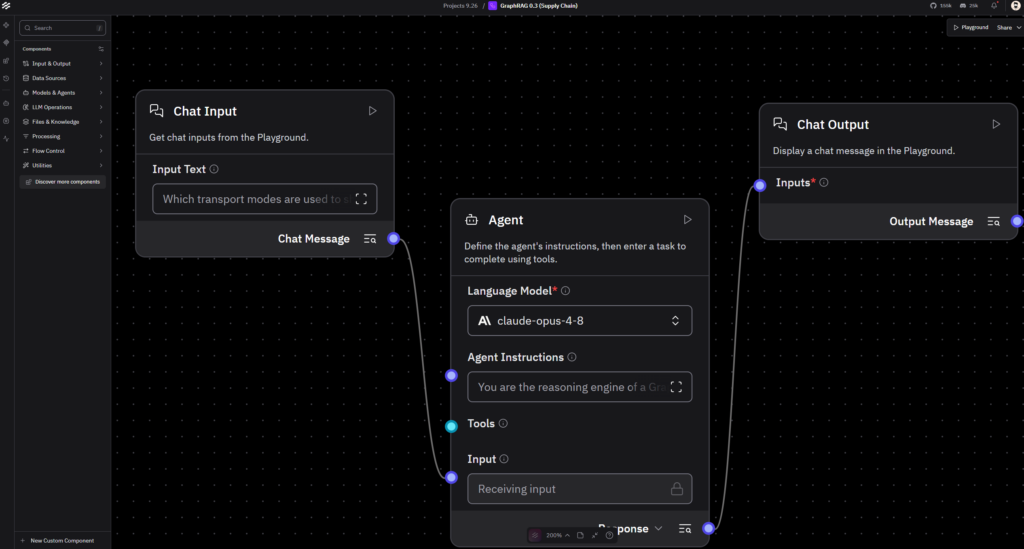
The overview shows a pipeline that was able to demonstrate and illustrate the functionality and benefits of a GraphRAG—in conjunction with a semantic model (Context Graph) in the W3C standard format RDF 1.2—for a customer in the context of supply chain processes.
Comprehensive (1080°) consulting for enterprises

I am offering another comprehensive (1080°) consulting service for businesses, titled "From Digital Obligation to True Competitive Advantage", in collaboration with two highly experienced partners.

360° Economic Viability & 360° Transformation & 360° Knowledge & Leadership

You can find details about this special offer in the flyer . Please feel free to contact us if you are interested or have any questions about our services.

Industry 4.0 Orchestrator and Validator Prototype

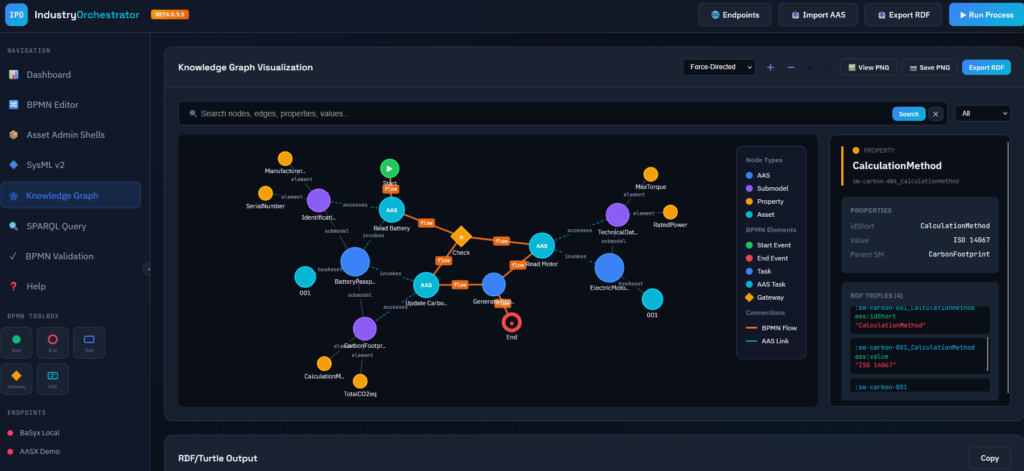
The first beta version of the IPO prototype is now available. The aim of this prototype is to demonstrate the comprehensive application of industry standards in combination with semantic solutions and Artificial Intelligence. Another key focus during development was the inclusion and integration of validation functions. The main applications of this prototype include the Digital Product Passport, the calculation of the product's Product Carbon Footprint (PCF) in accordance with the ISO 14067 standard, and integration into the company's process landscape. An agile, incremental approach was used to develop the web application.

IPO Prototype – Visualized Knowledge Graph with detailed view and search function

The standards supported in the IPO prototype are BPMN 2.0, SysML v2, AAS (3.0) with submodels, RDF/Turtle, SPARQL, and SHACL. Import and export functions are available for SysML, BPMN 2.0, SysML v2, and AAS.

Digital Product Passport and Interoperability

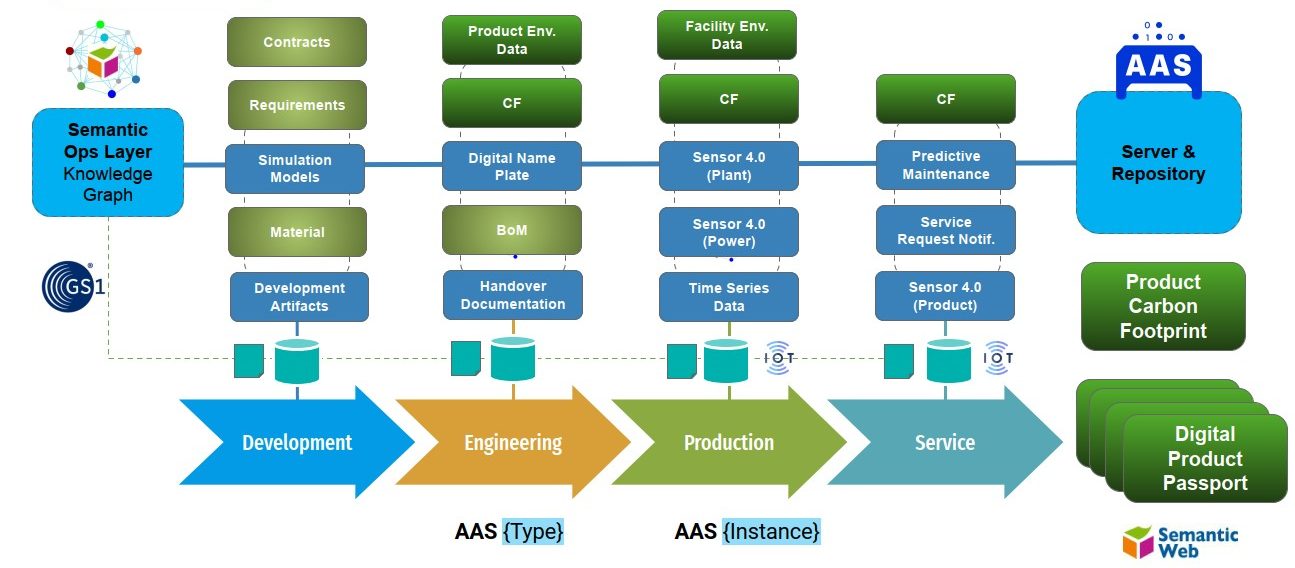
The Digital Product Passport requires access to all relevant data as well as the "semantic interconnection" of this data within a company. Furthermore, connectivity with external data from suppliers and partners is also necessary. This interoperability—which also supports the exchange of Digital Twins—can be achieved through the use of the open standard of the Asset Administration Shell (IEC 63278-1). In addition, full interoperability requires seamless integration with existing business processes and models within the company, such as in Product Engineering / Model-Based Systems Engineering, as well as the orchestration of relationships at the data, model, and process levels. Model-based methods and descriptions (BPMN 2.0, SysML v2, AutoML, LLM, Predictive Maintenance) are already applied in many subareas of companies. The complete networking of these complex contexts and aspects can be realized using a semantic enterprise model based on World Wide Web Consortium (W3C) web standards, thereby contributing to further value creation within the company.

Note: I held this presentation in November 2025 at the tekom annual conference (Arena) in Stuttgart.

Use Case: Digital Product Passport

This presentation from Semantics 2023 explains the key points of the European Green Deal, related sustainable product initiatives and standards, and—as a use case—concepts for implementing the Digital Product Passport (DPP) based on the latest technologies and frameworks, such as the application of the Asset Administration Shell (AAS) in combination with an Enterprise Knowledge Graph (EKG).

Download presentation (PDF, 2.5 MB)

Turning data into knowledge

In recent years, various definitions and approaches have been developed that deal with data, information, and knowledge management.

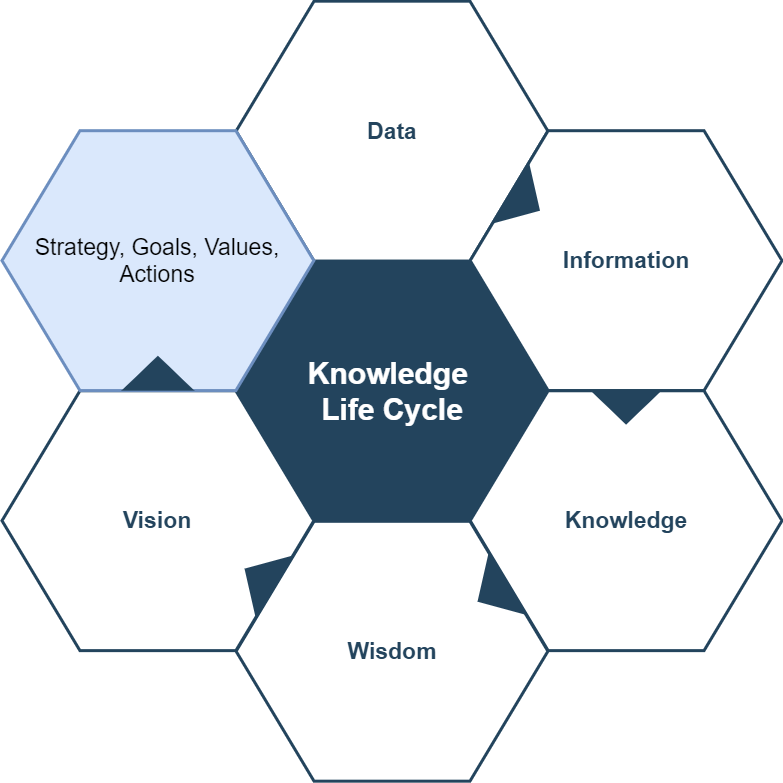
It is advisable to view this within the overall context of a company or institution. The following diagram illustrates the complete, iterative cycle while taking intermediate phases into account.

Knowledge management as a lifecycle

For a closer explanation, let us examine the phases in more detail, starting with the „Data“ phase.

  • Data – Data refers to recorded values presented in a structured format through metadata descriptions.
  • Information – Data combined with context that explains its meaning.
  • Knowledge – Knowledge is information that undergoes cognitive processing by domain experts and is subsequently available in a structured form (explicit). Uncaptured knowledge, acquired for instance through intuition and experience, is referred to as implicit.
  • Wisdom & Insight – Making decisions and taking action requires intelligence (sagacity) paired with insight and understanding, which can be validated and applied through knowledge.
  • Vision – Knowledge combined with intelligence forms the foundation for forward-looking planning and the realization of vision.

During the data management process, Discrete Data are initially transformed into Connected Data. Connected Data can be described and managed using a Knowledge Graph or a Knowledge Forest.

Semantic Web

The Semantic Web represents a stage of evolution in the World Wide Web. It extends the web to make published information and data machine-readable, exchangeable, and usable between systems. Information is enriched with explicit meanings and supplemental details, allowing both humans and machines to recognize the meaning, context, and broader connections of the data (the semantics).

The Semantic Web is based on knowledge modeling and knowledge representation (for a knowledge domain).

Tim Berners-Lee (founder of the World Wide Web) described his proposal in 2001 as follows: „The Semantic Web is an extension of the current web in which information is given well-defined meaning, better enabling computers and people to work in cooperation“.