Industrie 4.0 Orchestrator und Validator Prototype

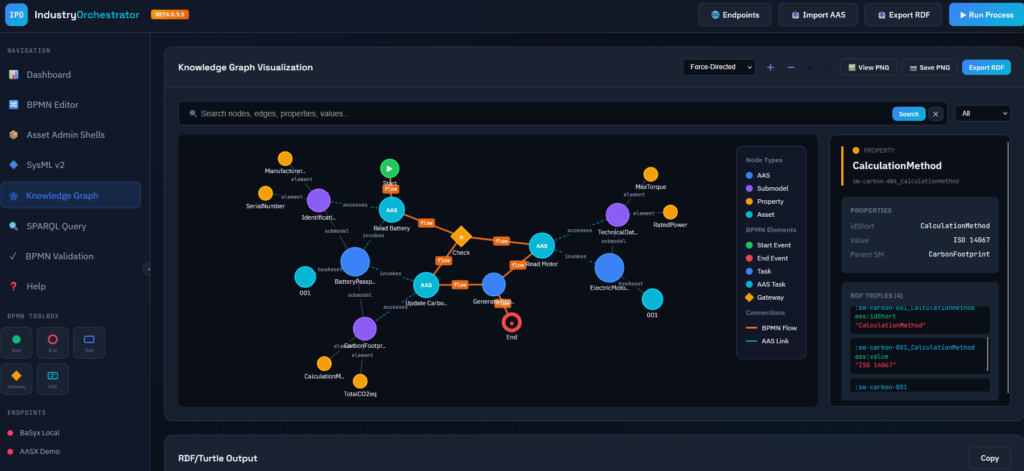
Die erste Beta Version des IPO Prototypes ist verfügbar. Ziel dieses Prototypes ist es, die umfassende Anwendung von Industrie-Standards – in Verbindung mit semantischen Lösungen und Künstlicher Intelligenz – zu demonstrieren. Ein weiterer Schwerpunkt in der Entwicklung war die Berücksichtigung und Integration von Validierungsfunktionen. Der Digitale Produkt Passport, die Berechnung des Product Carbon Footprint (PCF) des Produktes nach Standard ISO 14067 sowie die Integration in die Prozesslandschaft des Unternehmens sind die Hauptanwendungen dieses Prototypes. Für die Entwicklung der Webapplikation wurde eine agile, inkrementelle Verfahrensweise angewendet.

Prototype des IPO – Visualisierter Knowledge Graph mit Detailansicht und Suche

Die im IPO Prototype unterstützten Standards sind BPMN 2.0, SysML v2, AAS (3.0) mit Submodells, RDF/Turtle, SPARQL, SHACL. Import und Export-Funktionen sind für SysML, BPMN 2.0, SysML v2, AAS vorhanden.

Digitaler Produktpass und Interoperabilität

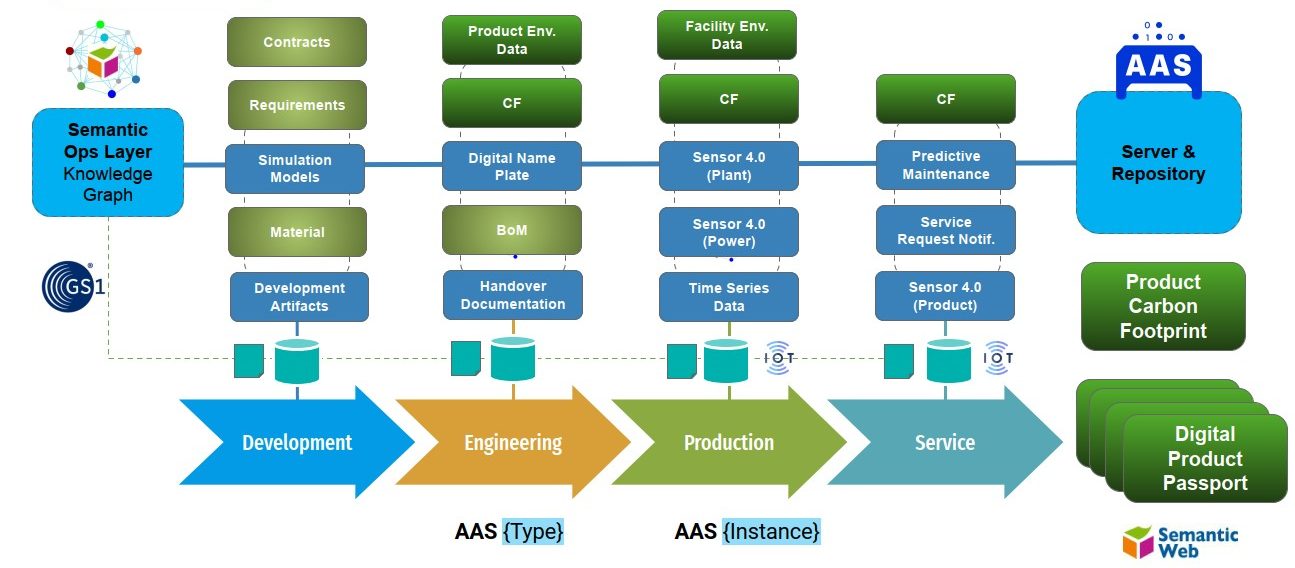
Der Digitale Produktpass erfordert den Zugriff auf alle relevanten Daten sowie die “semantische Vernetzung” dieser innerhalb eines Unternehmens. Darüber hinaus ist auch eine Vernetzung mit externen Daten der Zulieferer und Partner notwendig. Diese Interoperabilität – die auch den Austausch von Digital Twins unterstützt – kann durch den Einsatz des offenen Standards der Verwaltungsschale (Asset Administration Shell, IEC 63278-1) erreicht werden. Darüber hinaus erfordert die vollständige Interoperabilität eine nahtlose Integration mit den bereits existierenden Business-Prozessen und Modellen innerhalb des Unternehmens, z.B. im Product Engineering / Model Based System Engineering, sowie eine Orchestrierung der Zusammenhänge auf Daten-, Modell– und Prozessebene. Modell-basierte Methoden und Beschreibungen (BPMN 2.0, SysML v2, AutoML, LLM, Predictive Maintenance) finden in vielen Teilbereichen der Unternehmen bereits Anwendung. Die vollständige Vernetzung dieser komplexen Zusammenhänge und Aspekte kann mit Hilfe eines semantischen Enterprise Modells, auf der Basis von Webstandards (W3C), realisiert werden und dadurch zur weiteren Wertschöpfung im Unternehmen beitragen.

Anmerkung: Diesen Vortrag hatte ich im November 2025, auf der Jahrestagung der tekom (Arena) in Stuttgart, gehalten.

Use Case: Digital Product Passport

Diese Präsentation von der Semantics 2023 erläutert die Kernpunkte des Europäischen Green Deals, zugehörige Sustainable Produktinitiativen und Standards und – als Use Case – Konzepte zur Realisierung des Digitalen Produktpasses (Digital Product Passport – DPP) auf der Basis neuester Technologien und Frameworks, z.B. der Anwendung der Asset Administration Shell (AAS) in Verbindung mit einem Enterprise Knowledge Graph (EKG).

Download der Präsentation (pdf, 2,5 MB)

Semantic Web

Das Semantic Web stellt eine Entwicklungsstufe des WWW dar. Es erweitert das Web, um veröffentlichte Informationen und Daten auch zwischen Maschinen lesbar, austauschbar und verwertbar machen zu können. Die Informationen werden mit eindeutigen Bedeutungen versehen und durch zusätzliche Details ergänzt, so dass Mensch und Maschine die Bedeutung, den Kontext und weitere Zusammenhänge der Information (die Semantic) erkennen können.

Das Semantic Web basiert auf einer Wissensmodellierung bzw. Wissensrepräsentation (für eine Wissens-Domain).

Tim Berners-Lee (Begründer des World Wide Web) beschrieb seinen Vorschlag im Jahr 2001 folgendermaßen: „The Semantic Web is an extension of the current web in which information is given well-defined meaning, better enabling computers and people to work in cooperation“).

Literatur

Dies ist eine kleine Auswahl empfohlener Buchtitel im Kontext von Knowledge Management, Semantic Web, Knowledge Graph, Taxonomy & Ontologie und Artificial Intelligence.

The KM Cookbook
Chris J. Collison et al., facet publishing, 2019.
Stories and strategies for organisations exploring Knowledge Management Standard ISO 30401

Knowledge Management Matters
John & JoAnn Girard, Sagology, 2018.
Words of Wisdom from Leading Practitioners

The Knowledge Graph Cookbook
Andreas Blumauer, Helmut Nagy, 2020.
The Knowledge Graph Cookbook explains why your organisation should invest in the development of knowledge graphs, and most importantly, what recipes exist for developing and integrating them in an efficient, successful and sustainable way.

Graph Powered Machine Learning
Alessandro Negro, Manning Publications, 2020*.
Graph-Powered Machine Learning introduces you to graph technology concepts, highlighting the role of graphs in machine learning and big data platforms. You’ll get an in-depth look at techniques including data source modeling, algorithm design, link analysis, classification, and clustering. As you master the core concepts, you’ll explore three end-to-end projects that illustrate architectures, best design practices, optimization approaches, and common pitfalls.
* Buch erscheint im Dezember 2020 – eine gekürzte Vorabversion „Essential Excerpts“ wurde im Juli 2020 veröffentlicht.

Ontology Engineering
Elisa F. Kendall et al., Morgan & Claypool Publishers, 2019.
Synthesis Lectures on the Semantic Web: Theory and Technology. Ontologies have become increasingly important as the use of knowledge graphs, machine learning, natural language processing (NLP), and the amount of data generated on a daily basis has exploded.

An Introduction to Ontology Engineering
C. Maria Keet et al., CC BY 4.0, 2020.
The principal aim of this textbook is to provide the student with a comprehensive
introductory overview of ontology engineering. A secondary aim is to provide
hands-on experience in ontology development that illustrate the theory, such as
language features, automated reasoning, and top-down and bottom-up ontology
development with methods and methodologies.

Semantic Web for the Working Ontologist: Effective Modeling for Linked Data, Rdfs, and Owl
Dean Allemang et al., ACM Books, 2020.
Enterprises have made amazing advances by taking advantage of data about their business to provide predictions and understanding of their customers, markets, and products. But as the world of business becomes more interconnected and global, enterprise data is no long a monolith; it is just a part of a vast web of data. Managing data on a world-wide scale is a key capability for any business today.

Semantic Modeling for Data: Avoiding Pitfalls and Breaking Dilemmas
Panos Alexopoulos, O’Reilly, 2020
What value does semantic data modeling offer? As an information architect or data science professional, let&;s say you have an abundance of the right data and the technology to extract business gold&;but you still fail. The reason? Bad data semantics. In this practical and comprehensive field guide, author Panos Alexopoulos takes you on an eye-opening journey through semantic data modeling as applied in the real world. You’ll learn how to master this craft to increase the usability and value of your data and applications. You’ll also explore the pitfalls to avoid and dilemmas to overcome for building high-quality and valuable semantic representations of data.