Eine weitere, umfassende (1080°) Beratung für Unternehmen „Von der digitalen Pflicht zur echten Wettbewerbsstärke“ biete ich, zusammen mit zwei sehr erfahrenen Partnern, an.
Im Flyer finden Sie Details zu diesem speziellen Angebot. Bitte sprechen Sie uns an, wenn Sie daran interessiert sind oder Fragen zu den Angeboten haben.
In den letzten Jahren wurden unterschiedliche Definitionen und Herangehensweisen entwickelt, die sich mit Daten-, Informations- und Wissens-Management beschäftigen.
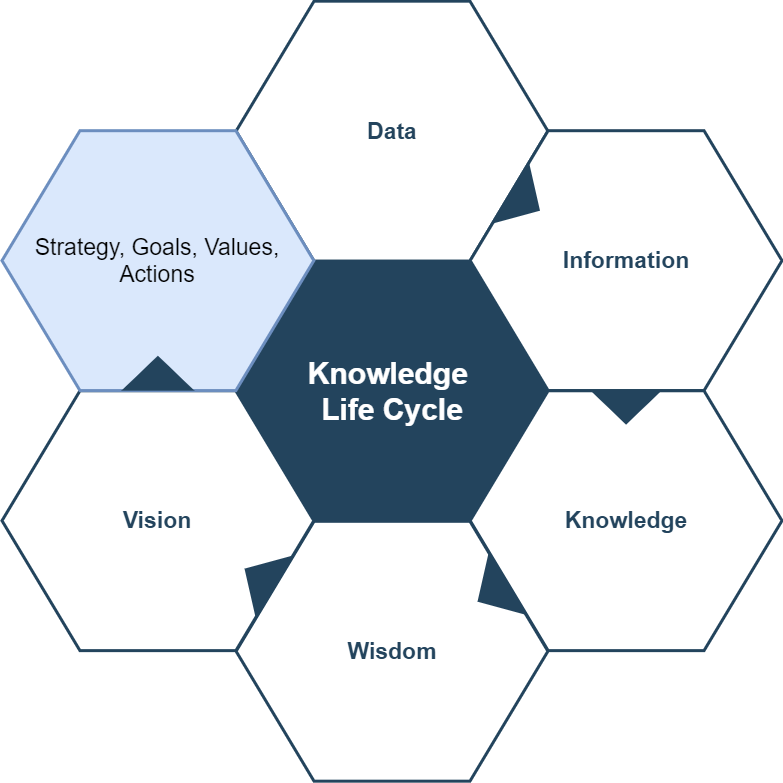
Es bietet sich an, dies im Gesamtkontext eines Unternehmens oder einer Institution zu betrachten. Das folgende Diagramm zeigt den gesamten, sich wiederholenden Zyklus unter Berücksichtigung von Zwischenphasen.
Wissensmanagement als Lebenszyklus
Zur Erläuterung schauen wir uns die Phasen näher an und starten dabei mit der Phase „Data“.
Data – Daten sind erfasste Werte, die durch eine Meta-Beschreibung in strukturierter Form vorliegen.
Information – Daten in Verbindung mit einem Kontext, der die Bedeutung der Daten erklärt.
Knowledge – Wissen ist Information, die eine kognitive Verarbeitung durch Domain-Experten erfährt und anschließend in strukturierter Form (explicit) vorliegt. Nicht erfasstes Wissen, welches z.B. durch Intuition und Erfahrung erworben wurde, nennt man implicit.
Wisdom & Insight– für Entscheidungen und Aktionen ist eine Intelligenz (Klugheit) zusammen mit dem Einblick und dem Verständnis erforderlich, die durch Wissen validiert und angewendet werden kann.
Vision – Wissen in Verbindung mit der Intelligenz bildet die Grundlage für eine vorausschauende Planung, die Umsetzung der Vision.
Während des Prozesses des Daten-Managements werden anfänglich Discrete Data in Connected Data transformiert. Connected Data lassen sich durch einen Knowledge Graph oder einen Knowledge Forest beschreiben und verwalten.
Einwilligung verwalten
Um dir ein optimales Erlebnis zu bieten, verwenden wir Technologien wie Cookies, um Geräteinformationen zu speichern und/oder darauf zuzugreifen. Wenn du diesen Technologien zustimmst, können wir Daten wie das Surfverhalten oder eindeutige IDs auf dieser Website verarbeiten. Wenn du deine Einwilligung nicht erteilst oder zurückziehst, können bestimmte Merkmale und Funktionen beeinträchtigt werden.
Funktional
Immer aktiv
Die technische Speicherung oder der Zugang ist unbedingt erforderlich für den rechtmäßigen Zweck, die Nutzung eines bestimmten Dienstes zu ermöglichen, der vom Teilnehmer oder Nutzer ausdrücklich gewünscht wird, oder für den alleinigen Zweck, die Übertragung einer Nachricht über ein elektronisches Kommunikationsnetz durchzuführen.
Präferenzen
Die technische Speicherung oder der Zugriff ist für den rechtmäßigen Zweck der Speicherung von Präferenzen erforderlich, die nicht vom Abonnenten oder Benutzer angefordert wurden.
Statistiken
Die technische Speicherung oder der Zugriff, der ausschließlich zu statistischen Zwecken erfolgt.Die technische Speicherung oder der Zugriff, der ausschließlich zu anonymen statistischen Zwecken verwendet wird. Ohne eine Vorladung, die freiwillige Zustimmung deines Internetdienstanbieters oder zusätzliche Aufzeichnungen von Dritten können die zu diesem Zweck gespeicherten oder abgerufenen Informationen allein in der Regel nicht dazu verwendet werden, dich zu identifizieren.
Marketing
Die technische Speicherung oder der Zugriff ist erforderlich, um Nutzerprofile zu erstellen, um Werbung zu versenden oder um den Nutzer auf einer Website oder über mehrere Websites hinweg zu ähnlichen Marketingzwecken zu verfolgen.