
When humans, AI agents, and humanoid robots are equally involved in business processes and value chains within a company, traditional hierarchical organizational structures often lack the agility required to respond immediately to market changes. In such cases, considering alternative organizational models can be extremely beneficial. Holacracy is one potential alternative.
Holacracy is a self-organizing operational model for businesses, formalized in 2007 by Brian J. Robertson. Instead of a traditional hierarchy consisting solely of individuals (arranged in groups, departments, etc.), it utilizes a structure composed of roles with clearly defined components:
- Purpose – the target, capabilities, and potential of the role,
- Domain – the assets and processes over which the role has sole authority,
- Accountabilities – ongoing responsibilities that the role fulfills within its domain or provides as support for other domains.
Activities are bounded by policies, which apply specifically to a given domain or centrally across the entire organization.
Roles are grouped and organized into circles. Structural changes are not "ordered" from above, but rather adopted collaboratively during governance meetings in response to a specific tension (a perceived discrepancy between the current reality and the desired state).
Es findet eine Trennung zwischen Rolle <> Person statt. Eine Rolle wird von einer Person „energisiert“. Was passiert aber, wenn der „Energizer“ kein Mensch mehr ist, sondern eine intelligente, selbstlernende (AI-basierte) Maschine?
An AI agent (e.g., an AI-based agent for maintenance diagnostics) has a purpose within a specific domain (e.g., "diagnostic recommendations for operating the 'HUMA-7' machine"). It independently executes ongoing accountabilities (monitoring machine logs, reporting anomalies, generating reports, sending notifications, and making predictions based on real-time data). Structurally, it is no different from a human role holder.
To illustrate this, a specific (fictional) yet technically plausible application—the production of a humanoid robot (HUMA-7)—was developed as a prototype. The simulated company employs 13 humans, alongside 6 AI agents and 8 humanoid robots. The prototype can be controlled and monitored using various visualizations, simulations, and optimization strategies. A core module of the prototype is the semantic model of the entire enterprise, which also contains time-dependent data and milestones in a semantic format. This model utilizes the W3C RDF 1.2 standard as a (temporal) context graph, thereby guaranteeing a complete semantic view of all operations at any given point in time—including retrospectively—as well as interoperability with other internal or external processes.
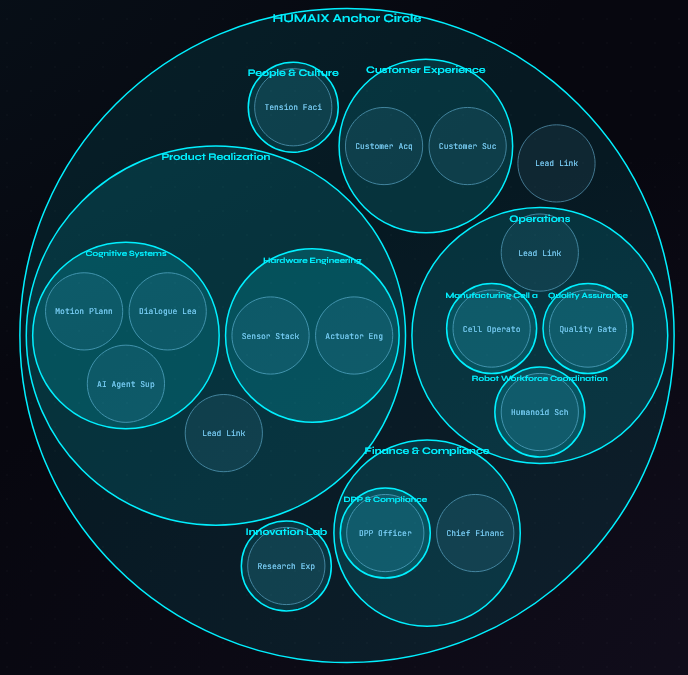
Overview of the company's circles & roles
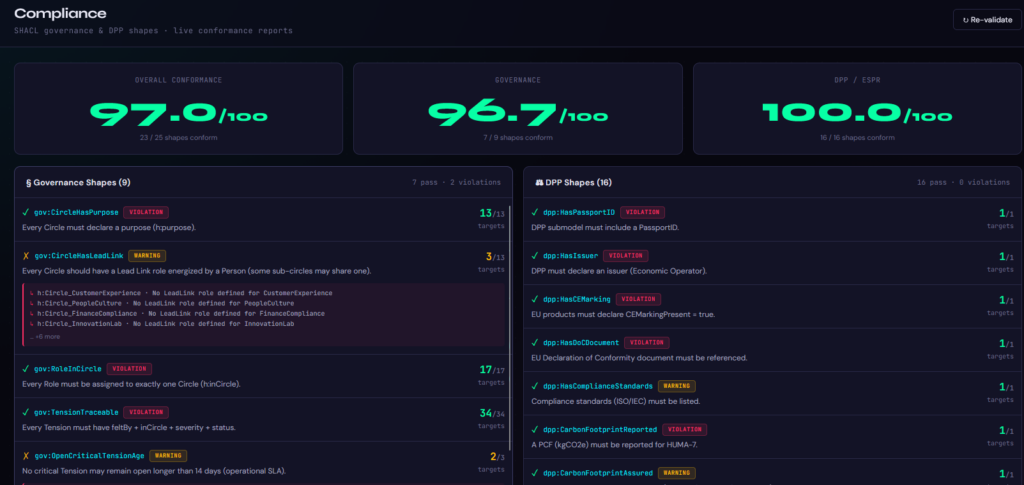
Prototype Governance and DPP Compliance Dashboard