
With the new W3C standard RDF 1.2, knowledge graphs can be effectively extended to include time, provenance, and confidence statements, forming a (temporal) Context Graph. This article outlines the fundamentals, several use cases, and the features of the prototype. The prototype provides visualization, import and export functionalities, as well as querying and validation capabilities using a SPARQL 1.2 engine and a SHACL validator.
A traditional Knowledge Graph answers the question "what is related to what?", represented as a directed graph consisting of nodes and edges. A Context Graph complements these statements with additional dimensions related to the context of the node, such as:
- valid-time — when was the statement valid in the real world?
- transaction-time — when was it recorded, confirmed, or revised?
- provenance and confidence — where does it come from and how reliable is this statement?
With the W3C standard RDF 1.2, this can be expressed very effectively using annotation block syntax – indicated by curly braces and pipe symbols – shown here for a giant sequoia in an alluvial forest, measured on September 1, 2015, at a height of 57.1 m.
wst:tree-auenwald  ws:heightMeters "57.1"^^xsd:decimal  {|
    ws:validFrom    "2015-09-01"^^xsd:date ;
    ws:source       wsb:post-hoechster-mammutbaum-deutschlands ;
    ws:certainty    "bestaetigt" ;
    ws:confidence   "1.0"^^xsd:decimal ;
    ws:recordedAt   "2015-10-01T12:00:00Z"^^xsd:dateTime
|} .
This extension of the knowledge graph offers significant added value, for instance, in connection with the product development process, the Digital Product Passport (DPP), or in the management of historical or regulated data. Data changes at specific points in time, sources shift, and new or updated regulations come into force – the context graph allows this to be fully documented and later utilized through queries and validations.
For the prototype, context graphs were generated from two different sources.
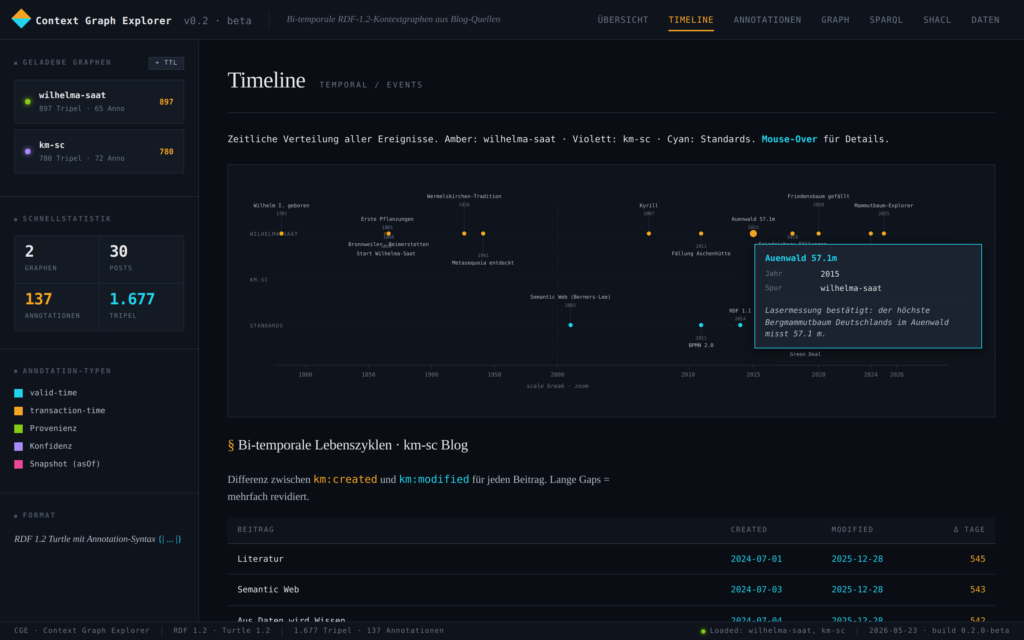
- Wilhelma-Saat — Publications on a nature project documenting the historical giant sequoias of the "Wilhelma-Saat" established by King Wilhelm I of Württemberg (dating back to 1864). The context graph contains 897 triples with 65 annotations and covers the time span from 1781 to 2026. ( https://www.wilhelma-saat.de )
- KMAIC Blog — The blog of the KMAIC website, with each post timestamped for initial publication and modification. The context graph contains 780 triples with 72 annotations. ( https://www.km-sc.de )
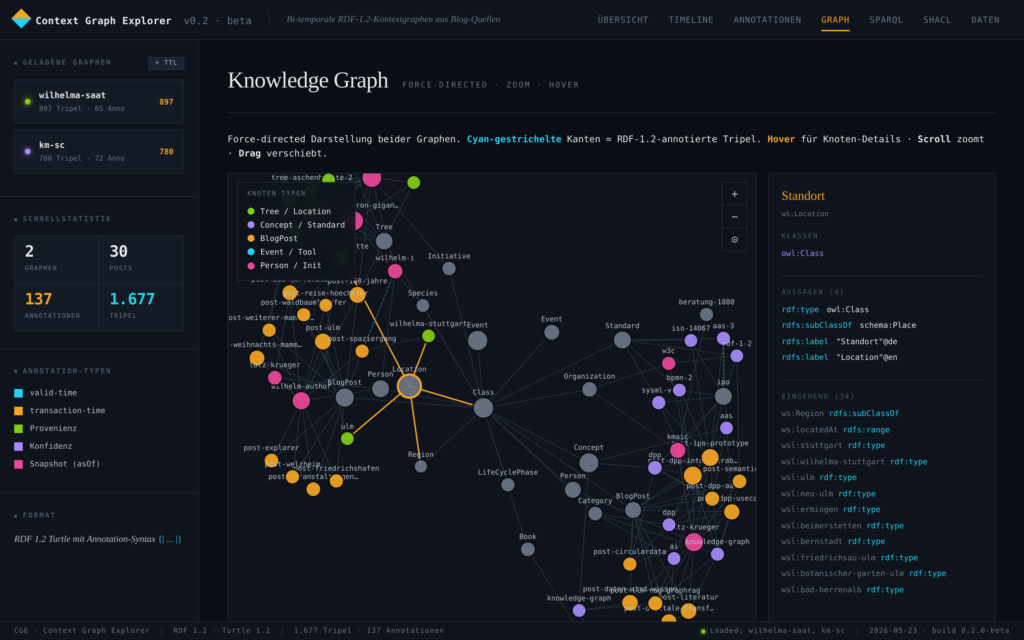
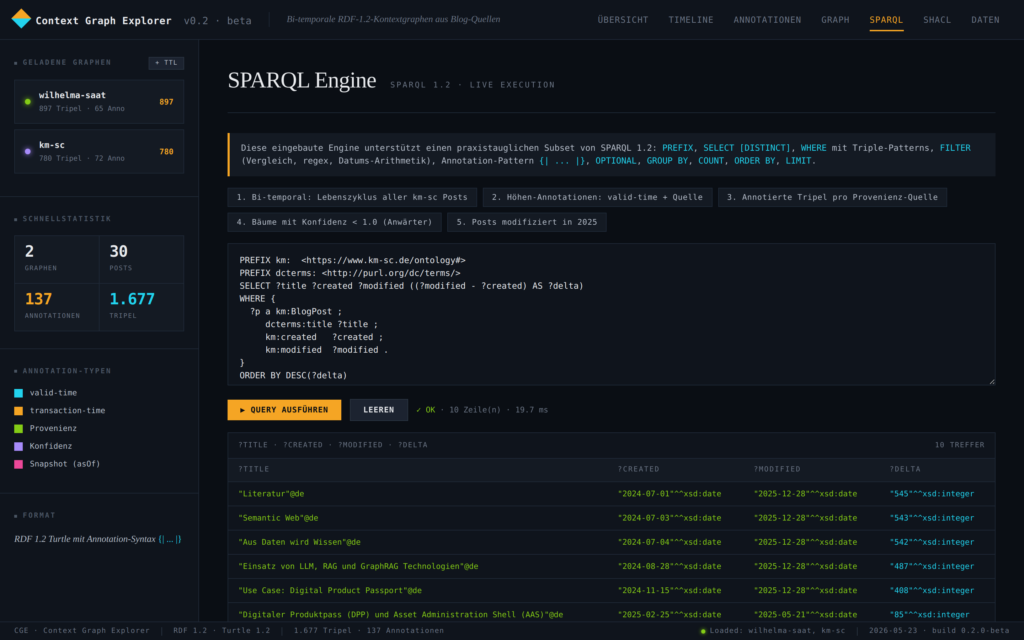
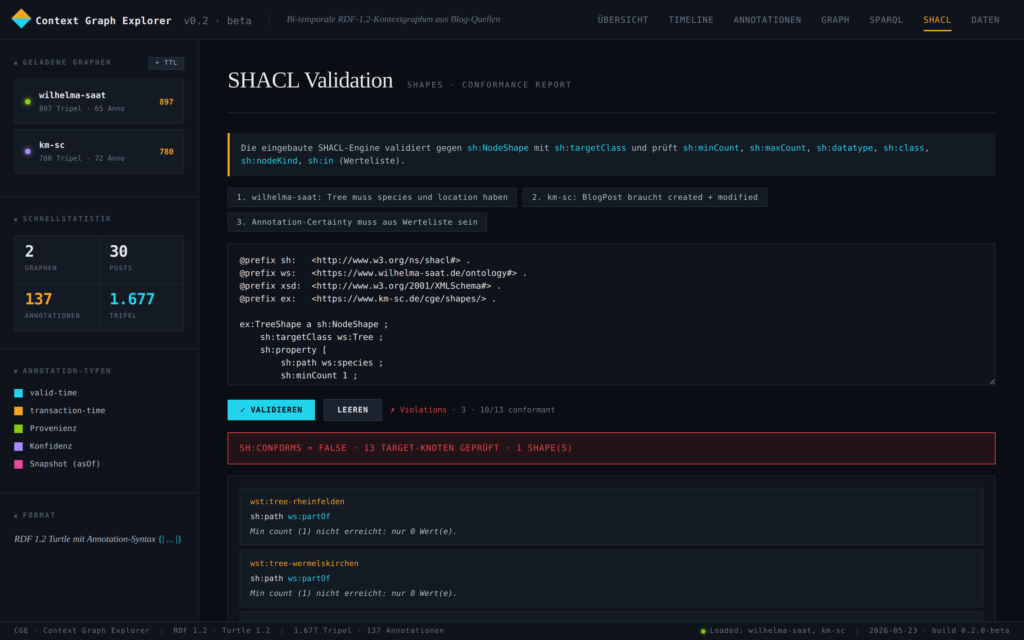
The prototype can ingest context graphs in RDF format and visualize them as a graph or timeline. Details can be queried using the built-in SPARQL engine, and they can also be validated using the integrated SHACL engine.
Outlook
A context graph represents the logical evolution of the knowledge graph. Its value becomes apparent where static statements without additional dimensions are insufficient. Additional applications and use cases are also beneficial in the following areas:
- Regulatory compliance (DPP, ESPR, Battery Regulation 2023/1542) requires traceable data origin and up-to-date status — both of which can be modeled directly as annotations, queried via SPARQL, and validated using SHACL.
- Product management, digital twins, and product carbon footprints require tracking when product properties change over time (maintenance status, recycled content, CO₂ footprint, etc.).
- Modern AI-based knowledge management systems benefit from provenance and confidence annotations when GraphRAG-generated statements coexist with validated statements from a domain expert — the context graph can indicate which source provided which statement at what time and how trustworthy it is.