Comprehensive (1080°) Consulting for Businesses

Together with two highly experienced partners, I offer another comprehensive (1080°) consulting service for businesses titled“From Mandatory Digital
to Genuine Competitive Strength.”

360° Business Efficiency & 360° Transformation & 360° Knowledge & Leadership

You 'll find details about this special offer in the flyer . Please contact us if you're interested or have any questions about the offers.

Use Case: Digital Product Passport

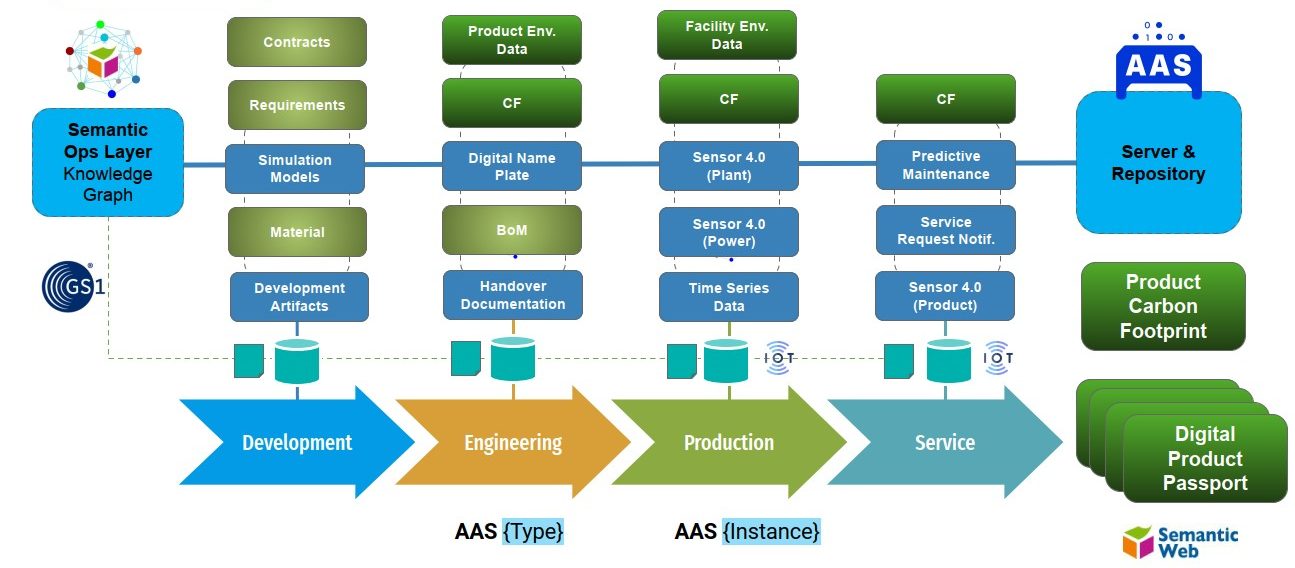
This presentation from Semantics 2023 explains the key points of the European Green Deal, related sustainable product initiatives and standards, and—as a use case—concepts for implementing the DigitalProduct Passport (DPP) based on the latest technologies and frameworks, such as the use of the Asset Administration Shell (AAS) in conjunction with an Enterprise Knowledge Graph (EKG).

Download the presentation (PDF, 2.5 MB)

Use of LLM, RAG, and GraphRAG Technologies

In today's digital world, large language models (LLMs) and related technologies play a central role in natural language processing and analysis. These models have the potential to fundamentally transform the way companies process and use information. In this article, we explain the concepts of LLMs, retrieval-augmented generation (RAG), and GraphRAG, and how they can be applied in industry.

LLMs are powerful AI models trained to understand and generate human language. They are based on deep neural networks and are trained using vast amounts of text data. This enables them to recognize complex patterns and relationships in language. LLMs are used in numerous fields, ranging from chatbots and virtual assistants to automated text analysis and generation.

Retrieval-Augmented Generation (RAG) combines the capabilities of large language models (LLMs) with information retrieval systems. Instead of relying solely on the trained model, RAG accesses external data sources to provide more accurate and contextually relevant information when generating responses. This method significantly improves the accuracy and relevance of the generated content by incorporating up-to-date and specialized information into the process.

GraphRAG is an extension of the RAG principle that leverages the structure of knowledge graphs to further optimize information retrieval and generation processes. Knowledge graphs represent data in a network-like structure that illustrates the relationships between different pieces of information. By integrating knowledge graphs, GraphRAG can provide deeper insights and well-founded answers by not only retrieving relevant data but also taking its contextual relationships into account.

These AI technologies offer a wide range of applications in industry. LLMs can be used to automate customer interactions or to support decision-making processes. RAG and GraphRAG enable companies to utilize their data resources more efficiently and make informed, data-driven decisions. These technologies can provide significant competitive advantages, particularly in data-intensive industries such as healthcare, finance, and logistics.

In summary, LLMs, RAG, and GraphRAG are powerful tools for transforming business processes. By integrating these technologies, companies can improve their efficiency, boost their innovation capabilities, and better adapt to market demands.

Digital Transformation and Cognitive Computing

Digital transformation refers to a comprehensive process of change based on the application of new digital technologies and agile approaches, which affects all areas and processes of a company or institution.

In the context of the application and integration of digital technologies, the term “cognitive computing” is also used, which is based on solutions from the fields of knowledge discovery, text mining, natural language processing, and machine learning.

The ability to adapt to changing conditions and information, as well as the systematic learning capability of all components—along with the ability to take the context of application into account—are the most important capabilities of cognitive computing.

Digital transformation (just like any knowledge management transformation) must take into account all areas of a company or institution; transforming technology alone is not enough (e.g., the organization, employees, processes, strategy—see“Core Elements of Digital Transformation”for more on this).

Semantic Web

The Semantic Web represents a stage in the evolution of the World Wide Web. It extends the Web to make published information and data machine-readable, exchangeable, and usable. The information is assigned unique meanings and supplemented with additional details so that both humans and machines can recognize the meaning, context, and other relationships within the information (the semantics).

The Semantic Web is based on knowledge modeling or knowledge representation (for a specific knowledge domain).

Tim Berners-Lee (founder of the World Wide Web) described his proposal in 2001 as follows:“The Semantic Web is an extension of the current web in which information is given well-defined meaning, better enabling computers and people to work together.”