
In recent years, various definitions and approaches have been developed that address data, information, and knowledge management.
It makes sense to consider this within the broader context of a company or institution. The following diagram illustrates the entire, recurring cycle, taking into account the intermediate phases.
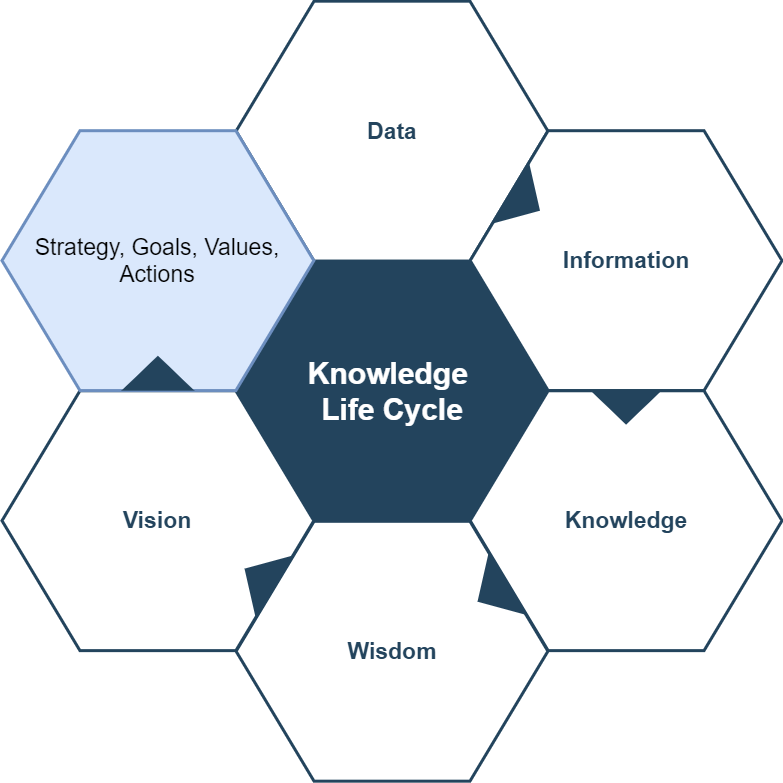
To explain this, let's take a closer look at the phases, starting with the "Data" phase.
- Data – Data consists of recorded values that are presented in a structured format through a meta description.
- Information – Data associated with a context that explains the meaning of the data.
- Knowledge – Knowledge is information that has been cognitively processed by domain experts and is subsequently available in a structured (explicit) form. Knowledge that has not been recorded—such as that acquired through intuition and experience—is called implicit.
- Wisdom & Insight—Decisions and actions require intelligence (wisdom) combined with insight and understanding, which can be validated and applied through knowledge.
- Vision – Knowledge, combined with intelligence, forms the foundation for forward-looking planning and the realization of the vision.
During the data management process, discrete data is initially transformed into connected data. Connected data can be described and managed using a knowledge graph or a knowledge forest.