
During the registration of individual Digital Product Passes or a collection of multiple Product Passes, an immediate verification is performed; if compliance is not met, this results in the complete termination of the registration process—even if, for example, only one pass out of a collection of 100 is invalid. Therefore, all Product Passes should be checked for errors before registration.
This prototype implements a comprehensive preliminary DPP Registry check that automatically retrieves the current validation rules and parameters for the relevant product segment (e.g., batteries) and validates the product passports—which are available as RDF graphs—based on W3C standards. The Registry’s specifications, in the form of SHACL shapes and SPARQL queries, provide detailed evaluations after the check is complete.
Various sample batches of batteries and textiles are tested in Prototype against EU Registry requirements. The following functions are performed during this process:
- RDF Model: Passport, product, economic actor, and code lists in a graph, described using RDFS and SKOS.
- SHACL: The registry rules as shapes, such as the UPI as an HTTPS URL with a maximum of 2,000 characters, the permitted granularity, and a unique UPI for each submission. In addition, there are battery passport data points that are mandatory depending on the category (EV, LMT, industry).
- SPARQL: Queries for missing required data points, such as the public view of a passport or the total fiber content of a textile.
- Graph: An interactive visualization of the product passports, in which nodes indicating violations are highlighted.
There are currently no registry requirements for textiles. The textile rules in the prototype are based on our own assumptions, are labeled as such, and will be automatically updated in the application once they take effect.
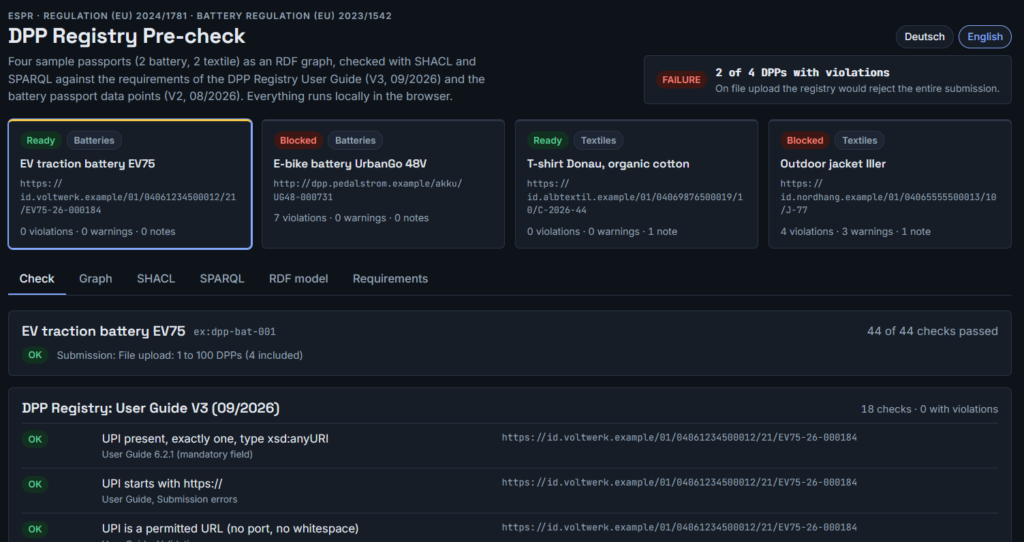
Prototype of the DPP Validator
In conclusion, it can be said that the semantic specifications for a battery product passport can already be formulated in a machine-readable format and automatically verified. As soon as the Commission publishes the semantic catalog and the technical guidelines for other product segments as well, the shapes in the application will be automatically adjusted.