
Those who describe their product data using open semantic standards can validate it using the same rules as the EU DPP Registry while also achieving interoperability with existing systems and suppliers without having to overhaul their architecture. The “DPP Registry Pre-Validation” prototype demonstrates the concept and outlines concrete steps for its implementation, supplemented with DPP examples from the battery and textile sectors.
The Digital Product Passport requires two things from companies. The passport data must be available in a specified, machine-readable format, and it must come from systems that were never designed for this purpose: ERP, PLM, MES, and numerous document management systems. For batteries, the DPP requirement takes effect on February 18, 2027.
As of October 30, 2026, the format leaves no room for interpretation. The Commission has published the Registry’s Semantic Data Artifacts: SKOS vocabularies, SHACL shapes, and JSON-LD contexts. The interoperability requirement is thus formulated directly in W3C standards. Those who implement these standards in-house are working with the original and not with a replica. The primary advantages can be described as follows.
A validation framework instead of custom rules. The Prototype uses the official SHACL shapes as-is. No one has to copy and maintain validation rules from a guide. When a new release is published, the official, semantic DPP artifacts are updated, and the validation logic can remain unchanged.
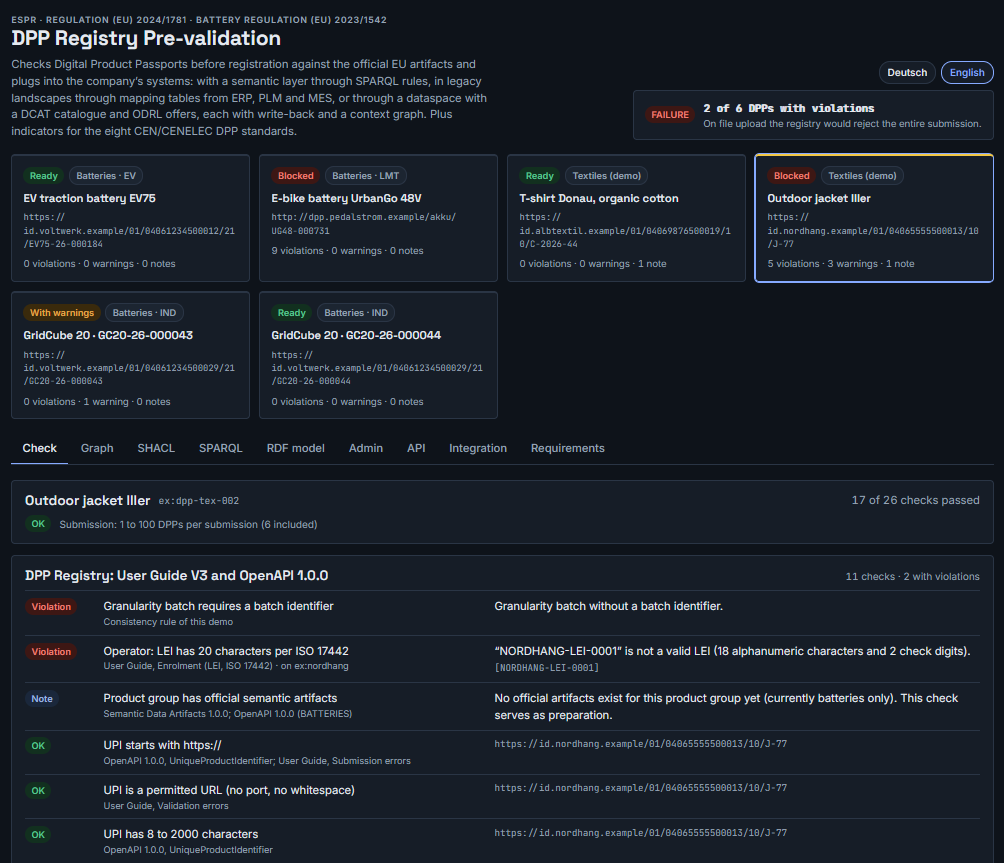
Find errors before submission. The registry will reject a submission entirely if even a single passport does not comply. The preliminary review identifies each violation with its official error code before it wastes time in the registration process.
Interoperability without vendor lock-in. RDF, SHACL, SPARQL, and JSON-LD are open W3C standards. The same data is stored internally as a graph and is sent to the registry in the official JSON format. There is no need for a separate data repository for the passport.
Traceability. A context graph records when a passport was issued from which system, as well as when it was verified, modified, and submitted. Questions from auditors and regulatory agencies can be answered using this data, such as: Which passport was modified and not re-verified afterward?
Reuse for future product groups and segments. The core layer of the artifacts applies to all product groups. Those who have integrated it for batteries need only add the relevant vocabulary and shapes for additional groups.
There are various ways to implement this solution. The prototype demonstrates three variations:
- Existing Architecture with a Semantic Layer
- (Legacy) Architecture Without a Semantic Layer
- Existing Architecture with Dataspace
Conclusion and Recommendation
The specifications for the product passport are published in open semantic standards. Companies or DPP service providers that use these same standards for their product data can verify their data against the original, remain independent of specific tools, and respond immediately to changes in the product, the DPP, and applicable regulations during live operations, rather than having to implement changes to the architecture.
Companies that do not yet use a semantic layer should treat the DPP not as a mandatory project, but as a first step toward a company-wide semantic architecture—starting with a core ontology, fully mapping a pilot product, embedding validation and rule synchronization, and only then scaling Agentic AI on this foundation.